Do you enjoy the sights, sounds, smell, and touch of the Prairie? How often do you wish you were once again standing on sites of past years; revisiting those memories, as clear as the day they were first formed? Do you want to experience new Prairie locales; the flora, fauna, and life events, and heritage? Join us on the Tallgrass for something we've been missing during the hustle of our daily activities...if this sounds like your "cup of tea", join us and enjoy the view!
Tuesday, June 2, 2026
Late Spring on the Prairie
Wednesday, July 28, 2021
It's Been Worse...Throw a Bit of Fun Into the Mix!
It's getting on into the end of July and a lot has transpired in the pasture. Its still very dry and warm...especially this week...temps in the mid 90's and a dew point that's nearly subtropical! We got lucky about 2 weeks back and received a little over one and a half inches of rain. VERY grateful for that! But still hauling water to the gardens and several smaller/newer trees that are showing stress.
I got a new toy a couple weeks back too...an older electric golf cart! I am breaking speed records for water hauling now. It is everything I thought it'd be - useful AND fun!
I call it the Prairie Schooner...been "sailing" all over the place in it and does it ever climb hills well! Both Georgie and I take it for a spin daily. carries 4 buckets of water in the back and a short filled one on the floor in front...when there's no well, and hoses don't reach 100's of feet, this is the next best thing and the ride cools you off too!
Even though its been quite dry (still in a "severe" drought) the pasture's plants have been doing their best. We're finding things are shorter in stature than "normal" years...and some plants have actually not bloomed and may not this summer now.
But here's a few that have been showing up since the last posting...
Wild Four-O'Clock (Mirabilis nyctaginea) with a nectaring Common Looper Moth (Autographa-precationis), along the road fence line on our native pasture. These almost always get past me (the Four-O'clocks), and when I seem to remember to look - they're about spent! I also see these Common Loopers often here...I guess their larvae feed on many things here like the asters and the verbena, as well as many other forbs. Plus I see the Eastern Bluebirds feed on the larvae frequently - everybody benefits! (photograph © Bruce A. Morrison)

A few more from the pasture...(top left to right) Swamp Milkweed (Asclepias incarnata), Purple Prairie Clover (Dalea purpurea), Lead Plant (Amorpha canescens) and White Prairie Clover (Dalea candida)...things are going to seed fast. (photographs - © Bruce A. Morrison)
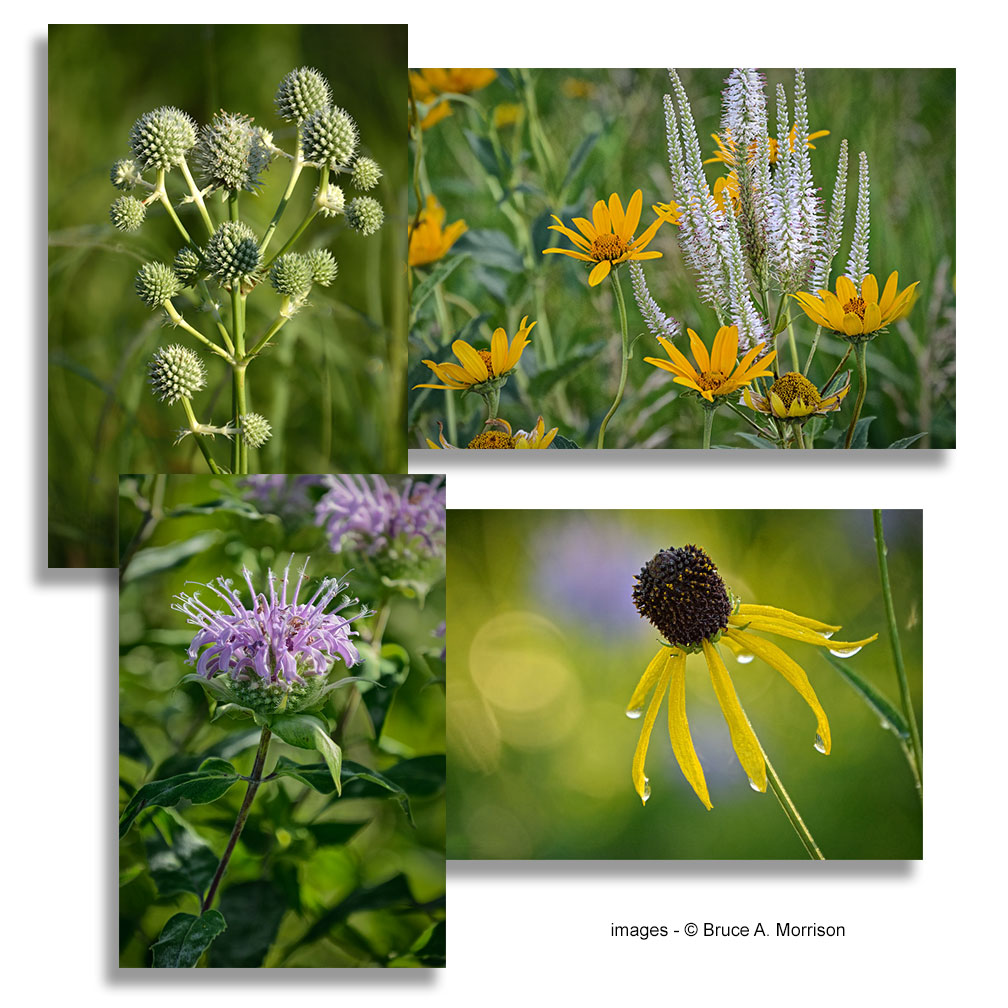
Top left - then clockwise - Rattlesnake Master (Eryngium yuccifolium), Ox-eye Daisy (Heliopsis helianthoides) with Culver's Root (Veronicastrum virginicum), Grey-headed Coneflower (Ratibida pinnata), and last - Wild Bergamot (Monarda fistulosa). Because of the current drought, the Rattlesnake Master has mostly gone dormant...out of the entire pasture only one has bloomed this summer so far. The Culver's Root, the Bergamot and the coneflowers are doing fine...the plants are shorter but still blooming well. (photographs - © Bruce A. Morrison)
Its been worse...hot and dry, but we're still fortunate compared to others - and we're making the best of it!
Wishing you a safe and peaceful summer out there! Be good to one another.
Tuesday, July 24, 2018
Mid Summer and Gorgeous!
The heat has just abated a little and the Black Flies (having undergone a second hatch) have finally calmed down a bit...now its the skeeters - but hey, the dragonflies, bats and swallows need to eat too! The prairie pastures have continued to wow me...the insects, birds, grasses and forbs are giving cause to pause and watch. Get out if you can...I know that life tends to get in the way, but a quiet walk is in order!
Friday, June 17, 2016
Late Spring on the Prairie!
Prairie Phlox (Plox pilosa)
Thursday, August 27, 2015
Plant of the Week - Sneezeweed (Helenium autumnale)
Saturday, August 8, 2015
Prairie Plant of the Week - Siphium laciniatum (Compass Plant)
It was also said that when in bloom, a gummy material forms along the upper 3rd of the main stem. This resinous material was used by Native Americans as a chewing gum.
Next time you're out on the prairie, walk up next to a Compass plant and see how it measures up! They're pretty cool in my book!
Saturday, August 1, 2015
Prairie Plant of the Week - "Evening Primrose"!
We have this plant on our prairie pasture frequently; most commonly along the gravel hillside and the gravel road going past our place. It volunteers quite easily and needs no seeding or help from us. It is really quite striking in large stands...I once found a stand along a railroad bed that was at least a hundred feet long and 12 feet wide - it was amazing!
Some Native American tribes collected it's seed for food and most first nation people used the "first season" roots - gathereed and dried for food. They were also adopted for food by the Europeans when they arrived.
They are great food plants for the birds and our pollinators - very important for all of us!
Thanks for stopping by - next time you're out along a gravel road or prairie remnant - look for this beautiful native prairie plant!
Friday, July 24, 2015
Prairie Plant of the Week - "Ratibida pinnata"!
Friday, July 17, 2015
Prairie Plant of the Week - Monarda fistulosa!
This week we have Monarda fistulosa - know by some folks as Bee Balm or Horse Mint. Most prairie folk know it as Wild Bergamot. Its a member of the mint family and is a common native over most of the North American prairie region. This is one plant that pollinators love - "Bee Balm" aptly describes how much bees like it...Bumble Bees in particular!
One thing I notice about Wild Bergamot is the heat of the summer matures the flowers very quickly and they just do not last long enough for me - if I don't get out there when they "peak", its too late for good pictures! We've had a couple days (today is one) with temps in the mid nineties and a heat index into the 105 and higher range...that's moving these flowers right along! I made a point of getting out the the past couple days and this morning to catch them before they wane.
Thanks again for stopping by - we'll see ya on the Tallgrass!
Plant of the week - Echinacea angustifolia
Thought I'd post a prairie flower from the pastures here once a week. I started this on my Face Book page and thought why not on the "A Tallgrass Journal" blog?!- Last week was Echinacea - most people recognize purple coneflowers, well this one is native to our county and some surrounding counties in NW Iowa - this one is Echinacea angustifolia - Narrow-leaved Purple Coneflower - not to be mistaken as Pale Purple Coneflower or Echinacea pallida (which we also have here). Your common garden variety - Echinacea purpurea is not native here - don't plant it in native settings, keep it in your yard.
Most sources do attribute the Echinacea pallida to being native in NW Iowa, so there's sometimes a question as to what you are seeing. The easiest visible difference is the longer/narrow "rays" (some folks think of them as petals) on the E. pallida...these rays also droop much more. Also the E. pallida is much taller - I've seen it regularly at 3-4 feet or slightly taller, whereas the E. angustifolia is much shorter (2-2.5 feet) with short rays.
Curiously, I have never seen E. pallida on a native prairie here in NW Iowa - just on reconstructed prairie or roadside plantings. The native pasture here had E. angustifolia originally as did the native prairies in the county's SE corner.
I actually think that our Narrow-leaved Purple Coneflower would make a great graden plant too!
Thanks for stopping by - see you on the Tallgrass!