Showing posts with label Bruce Morrison Artist. Show all posts

Saturday, June 24, 2023

June is "Dickcissel Month"...Just Say'n


(color pencil drawing - ©Bruce A. Morrison)

I got an idea last summer, reveling in all the Dickcissels living along our road and pastures. Nothing deep or serious mind you...and selfishly - something just for my own fun. I have to keep reminding myself - if you aren't having fun, then knock off what your doing and get to it...life is too short! 
 
I don't exactly recall why or how I came to this idea? Maybe it was all the perseverance these birds were being educated to each day - forming and raising families...staking their territorial claims and announcing that every day...all day long. Its really quite something to see and hear throughout the summer months.
 
I decided to just have fun and dedicate this artwork to them...all the graduates of Prairie Hill Farm - Class of '22. They wouldn't all pose for their class pictures but I got a few of them...mostly the guys of course, but a couple girls showed up as well.
 
Making this reminiscent of an old country school class composite did present some issues for me.  Color pencil is not a good tool for lettering nor graphics...I almost gave up the silly idea half way through, even before getting to the birds. I should've farmed that part off to someone who is actually "Good" at lettering and calligraphy...like our Daughter-in-Law Amy, she's a "Natural" at design and lettering - just look around our house!
 
The birds were fun - as was the central image representing their "school grounds"...putting everyone in a oval was "not" fun...not an easy shape constraint for my tired eyes and hands.
 
But here's to the "Prairie Hill Farm Summer Academy - Dickcissel Class of '22" - of whom many graduates returned this year and every year, to school their young and bring them up to be proud little Dickie Birds (as someone once called them)!!!
 
(color pencil drawing - ©Bruce A. Morrison)
 
I decided to declare June as "Dickcissel Month", in honor of these little birds and the memory they leave behind after they head south at summer's end.   I still have a glimmer of a seed to sprout a more serious Dickcissel piece someday...maybe a painting, who knows?
 
But I still remind myself not to take things too seriously, and have fun in the moment!
 
Be good to one another out there - hope to see you on the Tallgrass!

Saturday, March 12, 2022

Winter's Last Breath? (Crossing Fingers!)


"Frosty Morning Light - Hay Rake" - oil painting - ©Bruce A. Morrison

Is it Spring yet?!!!  One below zero Fahrenheit this a.m., but above freezing this afternoon...a good southwest wind bringing up the warm air - welcome!  This is the beginning of several warm days in the 40's to 60's, so looking forward to it!

I've been cranking out winter themed work the past month...had to get them out of my system before work outside on the acreage presents itself.  I don't do loads of winter artwork, but had these in my memory file; if I don't get them down I can lose them.  I just have so much memory available in this old hard drive (my brain)...if something new or memorable comes by - something has to go.  I find my brain deleting memories a lot these days...hey, it happens to all of us eventually.

The oil painting above is of my favorite acreage "prop"...I wish I had one or two more different types of old farm machinery that I could place here or there on the pastures, but this one is just perfect.  The old John Deere hay rake came from an artist friend's family farm - he even remembers using it each summer, then bailing afterwards.  It was his Grandfather's, then his Father's...his Dad just passed away about a month ago.  Although it wasn't the purpose of the painting, I suppose you could think of it as a tribute to his Father and Grandfather, representing their farming heritage and years now finished.

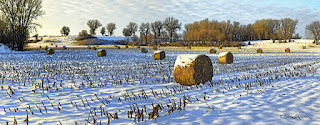
"Litka's Winter Bales" - color pencil drawing - ©Bruce A. Morrison

The next artwork is a color pencil drawing that about finished off a couple pencils...especially the blue one...lots of shades of blue in there!  This was a winter scene about 4 miles down the road from us...on a piece of property that the owner has let me walk for years.

We have not had much snow this winter...what we did get was fairly fleeting.  So both works were done from older photo files I had to dig up from my system folders.  Winter images aren't the best sellers for me but I'll admit that I'm not all about supporting this habit anymore.  Life is too short and doing what makes me happy has become more pleasing and important for my well being.  And if something "does" strike someone and goes to a new home - that's a double good thing! 

As I mentioned, the winter has been a dry one...we did a pasture inventory yesterday afternoon and it is obvious we cannot burn this spring unless things turn around and the rain comes.  We keep mowed paths between the paddocks, and along property boundaries for fire breaks...these are usually very green once the snow melts and the spring comes.  Any burning we do is helpfully controlled by the green/short mowed barriers.  These "barriers" are toast brown and tinder dry this Spring.  Even with "all hands on deck" (my wife and I) there is no safe and secure way to burn right now.  If the rain comes, maybe a late spring burn will be possible?  

We did do a couple limited fall burns last November though...I did an Elm sapling/volunteer killing campaign for some weeks in September and October.  There were too many for me to keep up with so I went back to a woody herbicide I used many years ago for poison ivy...Garlon 4.  I'm not fond of herbicides but I found myself completely at the mercy of the Elms - they multiplied exponentially over the past several years, and just plain got past me.  The Elms on the neighbor's grounds are still supplying seed - even though they're all in stages of decline.  

The Garlon 4 is sprayed on, so quiet mornings with no breeze is perfect as long as the volunteers have green foliage to take it in (although I believe epidermal absorption still factors in).  Several trips of spot spraying over a few weeks was necessary because there are always those plants that eluded me and some volunteers that needed multiple hits.  Once the pasture was speckled with dead reddish brown leaves and no green, then I set about with seeding plans for the late fall.

It was a busy fall in 2021 for seed gathering...mostly from our own ditches and the north pasture.  It wasn't as much as I needed but seed purchases are off the radar here in these times of limited income.  I was able to seed maybe 60% of the northwest pasture with what I had - I seeded on December 15th as there was a winter snowstorm coming in the next day.  Well...the next day we got snow...horizontal snow...our first ever recorded "Winter Derecho" - very high straight line winds.  I'm sarcastically guessing that ALL of my seeding was stripped from the NW pasture, as NO snow stuck to that pasture - it was as clean as a whistle after the storm...oh well - I tried.

We had a lot of limbs down after that storm but thankfully nothing serious.  We lost part of our sheep barn's roof but nothing we can't fix this spring.  In that effect we were very fortunate here!

We'll see down the road if any pleasant surprises still come about from the seeding I did.  I'm not holding my breath though.

But Spring is coming!  And we're looking forward to it!

Have a Blessed Spring out there...so many will not, especially in the Ukraine and possibly the Baltics...praying for peace in this world with all my heart.

Please be good to one another.  Hope to see you on the Tallgrass!


Saturday, March 5, 2016

Going Domestic...Sort Of...

"Purple Prairie Clover (Dalea purpurea) with European honey bee (Apis mellifera)"
Color Pencil drawing -  © Bruce A. Morrison
 
It's been some time since I've posted on A Tallgrass Journal, with my art studio journal being a more daily focus, I almost forget during the "off season"!  But this one relates a bit so I thought I'd cross over and add it here too!
 
I've read that there are around 4000 species of native bees in North America (http://bugguide.net/node/view/8267) - that seems like an awful lot!  I believe I have read that there are around 30-40 species of  Bumble Bees in Iowa...and many many more species of other less conspicuous native bees in addition to that.
 
But most of us think of the "honey bee" when bees are mentioned.  I remember my grand father bringing us gallon jars of honey when I was a kid...he had a bee keeper keeping their hives on his farm and they'd give him honey for "rent".  I was a honey crazed kid - loved the stuff!  I'm afraid I still do but have to moderate my love for it a bit now.  But the main reason I wanted to have someone keep their honey bees here on our acreage was to help pollinate our berry and fruit tree crops.  Even then, they still get plenty of competition from the native bees and other pollinators.
 
Our pastures are "native" pastures with plenty of native species of gasses and forbs (wildflowers).  Here is where the native bees seem to really shine...I see many types of Bumble Bees there as well as a small Metallic Green Bee that I particularly enjoy watching - just a gorgeous little bee!
 
But the European Honey Bees like the wildflowers in the pastures as well, especially when the garden plants have finished flowering or haven't cycled to new blooms yet.  One flower the Honey Bees especially like are the Purple Prairie Clover (Dalea purpurea); this forb is also a favorite of Bumble Bees.  When deciding to do a color drawing of the Purple Prairie Clover, I intended just drawing the flower/plant itself but when going through my files for a subject to draw from, I noticed a lot of photos with bees!  So...in tribute to my sweet tooth and love for honey - I included a Honey Bee.
 
Here's to ALL of our pollinators - may we have a long and ever lasting relationship, and may it always be a good one!

Saturday, August 8, 2015

Prairie Plant of the Week - Siphium laciniatum (Compass Plant)

Siphium laciniatum (Compass Plant)
photograph - © Bruce A. Morrison
(click on image for a larger view) 

This week's prairie plant features the Compass Plant; this plant is fairly iconic on the tallgrass prairie - a large plant, usually towering above me as I walk through the mid to late summer prairie.  The birds love their seeds and this plant provides a solid platform for many bird nests as well.

I first spread seed for this plant in our first year here at the acreage and five years later we had flowering stalks 5-8 feet high!  It was well worth the wait I'd say, but I'd recommend only seeding for 2-3 years (maybe less) and then wait for the plants to establish, otherwise you'll have stands too thick to navigate!

Siphium laciniatum (Compass Plant)
photograph - © Bruce A. Morrison
(click on image for a larger view)
 
The leaves on Compass Plants are very distinct and quite large and handsome.  The plant gets it's common name from the leaves tending to orient themselves in a general north-south direction...they are very large, a foot or more in length and half a foot or more wide...very thick and substantial to say the least!

The yellow flowers are 3-4 inches wide and are alternate up the plant's heavy/thick stem.  They attract a great variety of pollinators too!

The Compass Plant's leaves and roots was used by several first nation tribes for many different uses...in the book "Wildflowers of the Tallgrass Prairie" by Roosa and Runkel, it is even mentioned that burning a dried root during a lightning storm acted as a charm to ward off lightning strikes...or hopefully so!
It was also said that when in bloom, a gummy material forms along the upper 3rd of the main stem.  This resinous material was used by Native Americans as a chewing gum.

Siphium laciniatum (Compass Plant)
photograph - © Bruce A. Morrison
(click on image for a larger view)
 
This is one plant that deer really seem to like in the early summer stage of growth but avoid later on when it gains height...I don't know how good of a forage it may have been to pioneers first settling the prairies but the Roosa/Runkel book says it was liked by cattle as well; likely being a reason it was pretty much eliminated wherever cattle were grazed year after year...I personally have found that cattle are very hard on native forbs, many will not sustain heavy grazing pressure like that year after year.

Next time you're out on the prairie, walk up next to a Compass plant and see how it measures up!  They're pretty cool in my book!

Saturday, August 1, 2015

Prairie Plant of the Week - "Evening Primrose"!

"Evening Primrose - Oenothera biennis 
Photograph - © Bruce A. Morrison
(click on image for a larger view)

This week's prairie plant is another forb (herbacious flowering plant) that most of us see in proliferation each season; though locally it does seem to have its boom and bust years.  The Evening Primrose, or Common Evening Primrose (Oenothera biennis) is a biennial (note the "biennis" in the latin name), so it takes 2 years to flower.

This plant tends to be grazed on by everything hungry though, and can tend to have some rather ratty looking stands in some years.  We have a large stand of volunteers along side the corn crib that have been skeletonized by this year's crop of grasshoppers!  There are also insects that tend to be found or associated with different plants.  The vertical image below has a couple insects on the top of the plant that can be seen with the Evening Primrose every season.  I'll plead ignorant of the insect's identity and it's association with this plant - something to look into for future reference!
 
"Evening Primrose - Oenothera biennis 
Photograph - © Bruce A. Morrison
(click on image for a larger view)

We have this plant on our prairie pasture frequently; most commonly along the gravel hillside and the gravel road going past our place.  It volunteers quite easily and needs no seeding or help from us.  It is really quite striking in large stands...I once found a stand along a railroad bed that was at least a hundred feet long and 12 feet wide - it was amazing!

Some Native American tribes collected it's seed for food and most first nation people used the "first season" roots - gathereed and dried for food.  They were also adopted for food by the Europeans when they arrived.

They are great food plants for the birds and our pollinators  - very important for all of us!

Thanks for stopping by - next time you're out along a gravel road or prairie remnant - look for this beautiful native prairie plant!

Sunday, June 29, 2014

From the Tallgrass at the Neal Smith NWR

 
This is a slight duplication from my Prairie Hill farm studio blog, but definitely prairie related.  And I'm afraid that this exhibit has taken much of my time this spring and early summer to prepare.  Oh, I have had the odd chance here and there to spend time in our own prairie pasture here...not a lot new there except I am finding more Prairie Garlic (Allium canadense) this year.  I believe I saw my first plant here in 2012; they are now in two separate locations...not a lot of plants but encouraging to find more.  I have not "knowingly" harvested this for seeding before, so I'm presuming I am either wrong in that respect or they were here to begin with and are just now making some effort to come back.

I am seeing some early success of the seeding I did in the south pasture "top" late in the winter.  I only had enough seed for about the top third of the acre there...I'm seeing asters, some Partriidge Pea, and some goldenrods and Gray-headed coneflowers (of course), and even some false Gromwell...which surprised me a bit because it always seemed slower on the start-up.  But the spot is weedy and nothing I can mow to assist things getting a head start.  I did spend an afternoon on my knees in there pulling weeds, and it hopefully helped.  Time will tell.

photograph - © Bruce A. Morrison
(click on image for a larger view) 

I got an interesting photograph there last week during some of our rain storms - some pretty wild clouds looking up that south pasture toward the SW.  I have no idea what these formations would be called, but for about 4 hours after this was taken, we had mammatus formations pop up constantly...an unusual evening.

The pastures started out very slow and somewhat sparse this spring - we hadn't had rain here since June of 2013.  But the sky busted loose in late May and it just doesn't seem to want to stop.  We've easily had over 13 inches of rain here since June 1st!  Not to mention hail and high winds...we're still cleaning up branches and larger limbs in the yard from a big blow that completely blocked our driveway with a huge tree trunk a week ago last Wednesday.

But more about the "From the Tallgrass" exhibit at the Neal Smith NWR.

Just 22 miles east of Des Moines, near Prairie City, Iowa, you'll find a truly unique refuge.  The Neal Smith National Wildlife Refuge was established in 1990, within the National Wildlife Refuge System, to "actively protect, restore, reconstruct and manage the diverse native ecosystems of tallgrass prairie, oak savanna, and sedge meadow. These were the native habitats existing on the Refuge’s 5600 acres prior to Euro-American settlement."

The refuge approached me in 2012 to do an exhibit of artwork and photography depicting the tallgrass, and I accepted.  This solo exhibit, at their J.N. "Ding" Darling Art Gallery, will feature work on the prairie theme and genre.

The exhibit will open on July 1st in the afternoon, and will run through August 20th.  More information about the Neal Smith National Wildlife Refuge, its hours and other contact information can be found online at - http://www.fws.gov/refuge/neal_smith

Its a great place to visit, as I've mentioned here on this blog in the past, and I'm looking forward to it!  If you're passing by the area this summer, take a little time and stop for a visit, you will be glad you did! 
 
Hope to see you on the Tallgrass!

Wednesday, March 5, 2014

Still Waiting...

 
"Prairie Lily"  
(Lilium philadelphicum) 
color pencil drawing - © Bruce A. Morrison 
(click on image for a larger view)


Still waiting in the wings for spring!  Aren't we all?!  But there is hope in the air with predictions of day time highs above freezing toward the end of the week! 

A year ago we were only days away from seeing our Great Blue Herons returning to the rookery across the valley and were seeing the area Bald Eagles sitting tight on their nest.   The Great Horned Owls are apparently incubating/hatching nearby...we see the top of the "sitter's" head when we pass by and crane our necks.  And the numbers of Mourning Doves is stretching a bit here on the acreage...we haven't seen huge flocks of Red-wing Blackbirds yet but a few individuals have been on the feeders in the yard.

But I've been working on early summer on the drawing board; another prairie forb  has grown to fruition.  I chose a lily that is native to my county (O'Brien) and still exists in a state remnant nearby.  I won't disclose its location as there are a meager few left and I don't want them stressed any more than they already are. 

I first came upon "Lilium philadelphicum" on the north shore of Lake Superior and in the adjacent forests, where it is locally known as the "Wood Lily".  I was quite surprised to find this beautiful small lily back in the mid 1990's here in O'Brien County when the state acquired a wonderful native prairie remnant; we walked the remnant the year prior to its public disclosure and found the "Wood" Lily on the prairie there!  I discovered the "Lilium philadelphicum" was one and the same as on NE Minnesota's "Arrowhead" region, and was pleased to call it "Prairie Lily" for the first time! 

I drew this color pencil drawing from that very same "first" Prairie Lily here...from a slide I took of the plant in bloom that morning of discovery. Hmmm, "slides", that's something I haven't worked from in a long while!

Its been cathartic doing these prairie plant drawings, getting that winter "thing" purged from my system!  I do hope to do more when I can.

I have an exhibit on the prairie coming up in July-August this summer, down at the Neal Smith National Wildlife Refuge near Prairie City, Iowa.  Neal Smith has a large and quite nice visitor center and the exhibit will be at the J. N. "Ding" Darling Gallery there.  The exhibit will follow my past "From the Tallgrass" theme, relating wholly to the Tallgrass Prairie.  I'll follow up more in a future blog on the details.

Still waiting and trying to be patient!

Saturday, August 31, 2013

Pasture Tramping

Eastern Black Swallowtail in Dotted Liatris
photograph - © Bruce A. Morrison
(click on image for a larger view)
Whew!  Its been a bit warm and humid for us lately!  But the summer marches on and things keep evolving and finishing out - you have to keep up!

A couple days ago Georgie came in the studio to let me know there was some butterfly activity going on out there, so I grabbed the camera.  There were a couple Monarchs in the pasture and a sulphur or two, but what really caught my eye was an Eastern Black Swallowtail...it appeared to have just recently emerged because of it reluctance to take flight and its flawless marking - no frayed edges or worn markings.

I also realized the heat had spurred the Dotted Liatris (Liatris punctata) into a peak bloom.  Things can get by a person around here if they get too busy!


Eastern Black Swallowtail on Stiff Goldenrod
photograph - © Bruce A. Morrison
(click on image for a larger view) 
The late summer forbs are now all moving along quickly here, the most dominant this time of year are the goldenrods - we are over run with Stiff Goldenrod (Solidago rigida) unfortunately...oh it is striking and a nectar favorite for all pollinators, but it is much too aggressive and is crowding out some very nice plants. 
 Monarchs on Stiff Goldenrod in our pasture on 09-02-2009
photograph - © Bruce A. Morrison
(click on image for a larger view)
At this time of the year we are usually over run with Monarchs, especially on the Stiff Goldenrod, but have only been managing one or two ever day or so...this is a disturbing  situation all over the country where they usually migrate through.  This subject is worthy of a blog entirely of its own I think. 
 
I've left another subject hanging in the background for a few weeks and just wanted to say that it is now "officially" proceeding.  I'll explain in a little more detail but don't want to make this too much of a soapbox as this blog is more about our place in the prairie and the tallgrass. 
 
Clean Line LLC is a corporation building large transmissions line around the country.  They are not a utility company in the states they are building, until they become franchised.  Once they become franchised in Iowa, they will have the same power of a utility, and in our case that means eminent domain.
 
They are building what they call the "Rock Island Clean Line".  They have been talking to the counties in NW Iowa for about 3 years or so about their proposed transmission line, so there is quite a bit of invested time for local governments and this corporation.  I only mention this "time investment" to give a background on the support for this endeavor by the county officials here in O'Brien County.  I am in the minority here if I do not support it, well I don't, so-be-it.
 
This transmission line would be the largest and longest to pass through Iowa.  It will be a 600kv line; would carry 1.3 times the equivalent power of the Hoover dam past our home and pasture each year.  Many things are unclear about this project, even though the "official" public informational meeting was supposed to clear things up. 
 
This is a "merchant line" (my words), the line is not coordinated with any existing grids in Iowa, even though it travels across 16 counties to the state of Illinois, it ties into no existing grid - it is solely being built to pick up electrons from wind power generated here in NW Iowa and sell it at higher rates in northeastern states. They do not have contracts with any wind farms in NW Iowa either; this is being built with the philosophy "if you build it they will come" in mind.
 
 "Waterman Morning"
photograph - © Bruce A. Morrison
(click on image for a larger view)  
* This is an actual location that will be clear cut in our valley
"if" the proposed line does go through.

I first heard about this line last fall when I read an article in the paper...I thought it odd at the time that we were allowing a line to be built just to take our produced power somewhere a couple thousand miles away.  Didn't we have use for power produced here ourselves?  We, after all, are so dependent on western coal for our local power...wouldn't our own wind power be beneficial and responsible for us and our region?  Then I read a quote by a county supervisor in the article.  The supervisor responded to a question or supposition by someone asking whether someone might object to the line going through their property, the supervisor responded by saying  (I'll paraphrase) "There's nothing in the county that a transmission line would bother."  That really got my attention!  I wrote Clean Lines LLC right away and asked them to please not take those supervisor words to heart - that there was indeed much in the SE corner townships that a transmission line could hurt or disrupt!  These two townships carry 99.9% of the entire county's natural heritage.
 
 Great Blue Heron
photograph - © Bruce A. Morrison
(click on image for a larger view)  
*The largest rookery of these birds in the state of Iowa (west of the
Mississippi River) will be disrupted "if" the proposed 
line does go through.
 
I thought at the time that this line was a done deal...the media reported it in that vein.  Well when we got a certified letter this July, telling us the transmission line would have its easement on our south pasture and would be 466 feet from our house, and pass across the valley past the largest Great Blue Heron rookery in Iowa, west of the Mississippi River, and through the northern most prairie remnants still found in this county - I began researching the corporation, its goals and its "behavior" and opposition in other states it is running through. I have serious doubts now as to how much "checking around" the local county officials did themselves with this corporation.
 
Clean Line LLC has been working in Illinois much longer at trying to receive a "franchise" status than it has in Iowa, because Illinois' utility regulations are much stricter than Iowa...they have been having quite a time there and the dockets in the Illinois testimony records are quite a read.  But this is the early stage for Iowa - out of the 16 counties it will pass through, there are still 10 counties that have not heard of any routes...there are still a lot of people who are unaware of their property's potential future.  
 
We are talking very large poles and/or towers.  They would all require blinking aerial lights.  The registered documents required in Illinois state that they could use grid towers of "200-240 feet or more"...a definite flight hazard for herons in a rookery access path and a definite "footprint" hazard for any prairie remnant in its path. (Just for reference - the statue of Liberty is 150 feet tall)  Oh, we were told at our public meeting on August 20th that this would have no affect on our property value...Uh...ya, the county will still tax you "as if" the transmission line and tower didn't exist, But...try convincing someone to buy that tower and huge lines too, when you try to sell your house!  Also, our studio is very much a "destination" business and that would inevitably suffer as well.
 
The corporation could not give any clients listed to hook onto their line when questioned at the public meeting.  They used the "patriotic American" card when asked why we could not use our area's wind farm electron production for "our region".  Is it unpatriotic to produce enough electrons for 1.4 million homes and not use it in our own region?  It certainly isn't "clean" energy when we have to use western coal here and not our own wind energy - its especially not clean to have to ship our electrons east when they are already needed here!!!
 
A large wind farm that was about to build in this area was just bought up by Mid American Energy (a franchised Iowa utility).  They just announced plans to build 600 or so wind towers.  Are they hooking up to Clean Line LLC?  No - they upgraded existing grids and are transmitting it themselves.  That makes perfect sense.
 
I won't dally further in this discussion, it is deeper than I've taken you so far, and its obvious where I stand.  If you are an Iowa resident and are possibly in one of the 16 Iowa counties or would just like to help us keep truly "clean" transmission in this state and our region - you can fill out an Objection Form with the Iowa Utilities Board using their electronic filing system online at http://efs.iowa.gov or by clicking on the link on their web site at http://iub.iowa.gov.  You can also support the grass roots organization which is forming across the entire state - The Preservation of Rural Iowa Alliance...become a member or just make a small donation to their cause - their link is here - http://www.iowastopricl.com   You can e-mail me if you have any questions about this at all.
 
Thank you for being patient with me.  And thank you for your support.

Monday, February 4, 2013

Past Ground Hog's Day!

 Red-bellied Woodpecker (male)
I must be too busy these days to keep up with all the blogs...its already a couple days past Ground Hog's day!  I guess he didn't see his shadow this year so we're in for an early spring!  Ha!  All in good fun.  
 
This is adapted from the studio blog but thought would make a good entry for the Tallgrass Journal as well.

I've been busy painting commissions this winter so don't have much to share yet.  But one thing that keeps things moving around here in the winter are the birds on the feeders outside the studio window.  One that's really pretty up close are the Red-bellied Woodpeckers!  Although not what you'd even closely describe as a prairie or grassland obligate, the Red-bellied Woodpecker is none-the-less common to the Savanna and prairie along the woodland edges.
 
 Red-bellied Woodpecker (female)
 
 (Red-bellied male's head detail)
 
  (Red-bellied female's head detail)

The way to distinguish the males from the females is the nape on the female's head is all that's colored (red), while the nape and crown on the male are both colored.  You can also see a red flush around the bird's beak and cheeks...its more prevalent on the male's as well.
 
 
The name of this woodpecker seems to confuse a lot of people.  Its named for the "red belly" - a mere smudge of color hard to see as the bird crowds the tree trunks and branches as it moves about.

We did manage to actually do a little seed collection out on the prairie pasture here yesterday afternoon!  It was really pretty pleasant for a change and we enjoyed it!  We had new visitors to the studio that also happened to be prairie enthusiasts, and in talking, found they were short some seed for their own private prairie restoration project - so we took a walk down the hillside here and did some gathering.  Although the birds have pretty much gleaned things pretty well, we still found a lot of what we were looking for. 
 
I like looking at February as a sign of spring - it is, after all, the last full month of winter!  Hope that Ground Hog was right - see you on the Tallgrass!


Thursday, March 22, 2012

Finally!


Pasque Flowers (Pulsatilla patens) on Waterman Prairie
Photograph © Bruce A. Morrison
(click on image for a larger view)

Spring is finally here and everyone's loving it!  Its really been here for quite some time...I'd debate its been here off and on since December!  Really weird weather the country is seeing.  There's a lot to debate about it too but I'll just enjoy what we're seeing for the time being.

Got out onto the prairie for the first time this year (if you don't count our prairie remnant here).  I knew I'd be late for the Pasque Flowers because the temps had been in the 70's-80's here the past couple weeks or so.  Yes they'd been up for a time it appeared.  A majority were showing a faded/worn look but the numbers were amazing; hundreds of plants scattered through the dead grass of last summer.

(click on image for a larger view) 

I've been buried in studio work all winter so this blog has been in hibernation so-to-speak.  I had committed to another one man show this spring so had to put in heavy easel time to get new things put together for it.  The theme is still "From the Tallgrass" , where else can my inspiration be coming from??!!  If you'd like to see paintings, drawings and photography from the tallgrass prairie in the next couple weeks, consider taking in the exhibit at the Witter gallery in Storm Lake.  There'll be an Artist's Reception on Thursday April 5th from 5:30-7:00 p.m.  Otherwise the exhibit will run from April 5 through the 26th.  It'd be great to see you!

The Monarchs are coming!
Photograph © Bruce A. Morrison
(click on image for a larger view) 

I've been following some "friends" this winter and spring (as usual) and I'm just amazed at how they're ahead of schedule!  It's being attributed to this "weather thing" but apparently the Monarch migration is about 3-4 weeks ahead of schedule.  I don't think they'll get too carried away unless their host plant (Asclepias sp. - the milkweeds) can keep up with their pace northward.  Last night I checked their progress, as I do each week, and they are already in Kansas and on the southern border of Missouri.  They don't usually hit these thresholds until April 15th or so...this is kinda spooky yet exciting!  I'll try not to get too worried about killing frosts just yet...I just thank God I'm not an apple or grape farmer here right now!!!

Have a great spring out there - hope to see ya on the tallgrass!