Showing posts with label Monarch Butterflies. Show all posts

Wednesday, July 15, 2020

Hot Enough For Ya!!??

 Eastern Bluebird on Common Mullein
(photograph - © Bruce A. Morrison)

Its been a warm one for sure and the faucet has been constricted a bit too.  And here we are in July already...geeze - mid July!  This is getting way out of hand; I know I'm easily distracted (Squirrel!!!!!!!!!) but give me a break!  This was once a weekly blog and now its almost quarterly!

We have been keeping busy around the acreage...the gardens are all doing extremely well thanks always to the Mrs. - Georgie runs a tight ship and works really hard at it too...been too much water hauling with the low rain this summer but its going well for her. 

Georgie and I started the early summer with a huge brome problem in the pasture where they laid a septic field in June of 2019...I mean huge!  Although there were some "survivors" in the disturbed part of the pasture, it actually turned into nearly solid brome.  Ugh.  

I started weed whacking it bit by bit and hauling our "hay", but it looked like a better method should be found.  Georgie started cutting it out - at the base of every clump - literally...I think it took maybe 2 weeks of every morning to get it done...I'm sure we could have made a nice big bale out of that mess!  Then I went through and treated clump stumps...its going to be a process - trying to get new things to survive in chest high brome is problematic to say the least.


Heliopsis helianthoides getting to be a real pasture/ditch bully here!
(photograph - © Bruce A. Morrison)

Other parts of the native pasture are doing well and other parts have issues too...just takes a lot of monitoring.  Interestingly one of the problem plant (forbs) this year is decidedly Heliosis helianthoides or False Sunflower...it has now completely filled the south ditch and has 30% of the north - spilling over into the north pasture!  Particularly bad in the NE triangle of that pasture.  I have spent a few days earlier in late spring chopping their bases and hauling them out but now can't even see where I'd done even that much!  This stuff is very hard to pull...a 2 year plant will "NOT" pull no matter how hard you try...its better to just suck it up and bend over (harder now than it ever used to be!) and cut it with a knife or pruning shear - this will take more effort on my part or things will turn a direction I don't even want to think about.


Wow the studio finally got a facelift!  Georgie was getting tired of having to paint the old siding - it would not hold paint, no matter the brand or cost...never did.  Plus the old used door was not very efficient - even took a picture this past winter of a snow drift inside the studio, yes "really".  So now I have a new door and siding, plus the contractor (Thanks Jeff Halverson!!!) even building wrapped the sides again and clad the wood window frames in aluminum so they don't have to be painted again either!  I'm spoiled.
 
  C2020 F3 (Comet NEOWISE)
(photograph - © Bruce A. Morrison)
 
Its comet month in July - C2020 F3 (Comet NEOWISE) has become visible to the unaided eye, both in the morning and in the evening...but only after dark.  It took me three tries to finally find it and get a shot (above).  My first mistake was thinking that 4:45 a.m. was early enough to get up and see it...wrong.  My second mistake was go out at 9:30 p.m. and see it...wrong again!   Ugh, frustrating.  But then I found some more specific times relating to viewing the comet...it just needed to be earlier or later...depending on the time of day of course. 

I finally found NEOWISE out back here after 10:15 p.m., but I had to first spot it with the aid of binoculars...I'd never have found it without them.  It's just too dim yet.  The above picture was taken with my 200-500mm lens with a 1.4 converter attached, which gave me 700mm at F8.  Now F8 is not fast by any stretch of the imagination but ramping up my ISO (ASA to old timers like me) to 3200 gave me the image above with a 1.6 second exposure.

If you're interested in seeing NEOWISE I'd recommend going out before 4:00 a.m. or after 10:15 p.m.  It is getting brighter but I'd still recommend using binoculars to "find" it first then you can see it without if you like. (Its much more interesting magnified of course).  In the a.m. look to the left of where the sun will rise (NE)...you'll see Venus rising at around the same time in the east - that is bright!  NEOWISE will be dimmer so it'll take some looking first.  In the p.m. look right of where the sun set that evening...in the NW.  You can use the pan of the Big Dipper as a guide...follow down and to the right and it will get you in the right vicinity...again use binoculars to help locate it first.  I believe its brightest (closest approach to the earth) is around the 24th of July, but there's no telling if it will hold out that long...comets are unpredictable.


Monarch on Compass Plant (Silphium laciniatum)
(photograph - © Bruce A. Morrison)

We are having a nice number of Monarchs here this summer...hardly a day goes by that I don't see Monarchs in "tandem" flight, and we're seeing good numbers of caterpillars as well.  But many other insects seem absent or at least in much lower numbers.  I judge this by what I encounter when I'm pulling weeds...I'm just not disrupting or bumping into things like I normally would have during other summers past.  But we have been having nice numbers of Lightning Bugs (Fire Flies to some) each night...if you look closely at the lower left corner of the photo above you'll see a Lightning bug resting under the forming blossom head.

In the meantime I'm taking much of the summer off...was out pulling brome in the pasture this morning and will likely be out this afternoon with the shears cutting out elms on the north pasture...elms and mulberries mostly...maybe a few locusts.  But if the sun comes out from behind our current overcast, I may call that off too - its been beastly hot this summer!!!  And dry - here any way!


Everyone stay safe out there and be kind to each other please.  See you on the Tallgrass!!!


Thursday, September 5, 2019

Roosting

The roosting has begun - they are on the move!  Actually its been a few days now, just getting the time to get around to reporting it.  But WOW we're having a fun time here with the show in the pasture each day and in the yard in the evening and morning!

(I partially blurred the number so our Florida
friend wouldn't get too many phone calls!)

This morning we had a "late" roost...they're usually out and dispersed/feeding by mid morning but today they were still roosting and clustering here and there out of the brisk wind.  It was 10:50 am when Georgie came and got me to look, as she'd been out doing chores and was seeing lots of action.

I brought the camera out and was watching all the roosts and amazed they hadn't dispersed when I saw a tag!  I photographed this on one of the soft maples on the north side of our grove, out of the wind...just sitting and resting.  And no wonder!

I called the tag number and spoke with a gentleman from Florida who was staying in Wisconsin, visiting his daughter.  He took the tag number and his daughter looked it up and found she had tagged "this very" Monarch individual on August 20th in Franksville, Wisconsin - north of Milwaukee about 10 miles - along Lake Michigan.

I don't want to name the person without his permission but he has been doing research on Monarchs for the past 10 years and started his research in Florida.  Florida Monarchs are unique in that they don't migrate - they are a resident population.  There is a parasite that Florida Monarchs are experiencing and they have been tagging these Monarchs and taking small samples from their abdomens (doesn't harm them) to check for the parasite...he referred to it as the "OE" parasite.  They do this work through the University of Georgia and have 160 volunteers in Florida doing the work.  Now his daughter is also tagging and checking the Monarchs (our migratory Monarchs bound for Mexico) and this one was tagged there in Wisconsin August 20th - very cool!!!

So far this Monarch has been flying due west of where it was tagged!  Maybe it heard we have loads of flowers here for nectaring (tongue-in-cheek)!?!  No wonder this poor critter was just intent to rest this morning...that's a long flight over the past 16 days!

I hope this Monarch makes it's way all the way to Mexico and we can hear from it again...wouldn't that be the greatest story!!!

Keep an eye out and enjoy the sight, soon they will depart...

Tuesday, July 24, 2018

Mid Summer and Gorgeous!

 Prairie Hill Farm
photograph - © Bruce A. Morrison

The heat has just abated a little and the Black Flies (having undergone a second hatch) have finally calmed down a bit...now its the skeeters - but hey, the dragonflies, bats and swallows need to eat too!  The prairie pastures have continued to wow me...the insects, birds, grasses and forbs are giving cause to pause and watch.  Get out if you can...I know that life tends to get in the way, but a quiet walk is in order!

(Click on any image for a larger view)


 Monarch Butterfly (male) feeding on Swamp Milkweed (Asclepias incarnata) 
in the pasture here at Prairie Hill Farm
photograph - © Bruce A. Morrison

 Mass of Cup Plants (Silphium perfoliatum) in bloom in the pasture
photograph - © Bruce A. Morrison

 Big Bluestem (Andropogon gerardi) 
photograph - © Bruce A. Morrison
 
 Hoary Vervain (Verbena stricta) 
photograph - © Bruce A. Morrison
 
 Culver's Root (Veronicastrum virginicum)  
photograph - © Bruce A. Morrison
 
 Fairy Napkin! OK...just a dew covered spider web! 
The "little fairy" can be seen peeking out from it lair in the upper hole in the web 
(should have zoomed in on him). 
photograph - © Bruce A. Morrison

 Gray-headed Coneflower (Ratibida pinnata) 
photograph - © Bruce A. Morrison

 Rattlesnake Master (Eryngium yuccifolium) 
photograph - © Bruce A. Morrison

 My favorites in the low areas of the pasture and ditches - 
Swamp Milkweed! (Asclepias incarnata)  
photograph - © Bruce A. Morrison

 Swamp Milkweed (Asclepias incarnata)
photograph - © Bruce A. Morrison

 Swamp Milkweed (Asclepias incarnata)
photograph - © Bruce A. Morrison
 
 Mass of Whorled Milkweed (Asclepias verticillata) - delicate little plants, balanced in the left foreground by spikes of Sideoats Grama (Bouteloua curtipendula) 
 photograph - © Bruce A. Morrison
 
 Mass of Whorled Milkweed (Asclepias verticillata)
 photograph - © Bruce A. Morrison

 Wild Bergamot (Monarda fistulosa) 
photograph - © Bruce A. Morrison
 
The prairie keeps changing - hopefully I can keep up and record it...if you get a chance - get out and enjoy it.

Hope to see you on the Tallgrass!!!

Monday, September 11, 2017

More Movement for the Monarch Migration Here

The big push has now gone through - for the fall Monarch Butterfly migration...they're still trickling through but not in the high numbers of a week back.  We had over a hundred at our highest one evening and morning.  This was nothing like 15 years ago when that number was over a thousand and more, but it is a slight improvement over just a couple years ago when a dozen was not attainable.
 
 
 Monarchs in the prairie pasture goldenrod here
Photograph - © Bruce A. Morrison
 
 Monarch in the prairie pasture New England Aster here
Photograph - © Bruce A. Morrison
 
 Monarchs resting on the Gray-headed Coneflower seed heads
in the prairie pasture here
Photograph - © Bruce A. Morrison
 
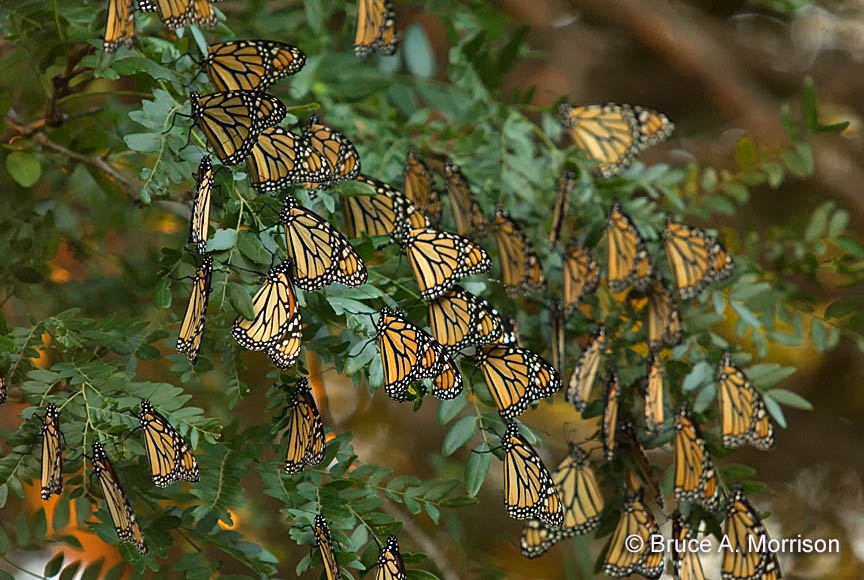
 Monarchs roosting in the grove here
Photograph - © Bruce A. Morrison
 
 Monarchs roosting in the grove here
Photograph - © Bruce A. Morrison
 
Now its up to the rest of their journey and the winter ahead in Mexico...I wish them the best of luck!

Monday, August 28, 2017

Monarch on Joe Pye
(photograph - © Bruce A. Morrison) 
click on image for a larger view
Late yesterday afternoon I was taking a photograph of this female Monarch butterfly on the Joe Pye weed next to the studio deck...somewhere in the back of my mind was the question - "When will the migration begin?  I believe it must be getting close."

"Valley Shadows and Clouds"
(photograph - © Bruce A. Morrison) 
click on image for a larger view
A bit later I noticed the clouds moving in with an intermittent breeze.  It felt like a front moving through.  I was distracted and spent some time looking skyward and photographing the landscape out front.  On my way back into the studio I noticed several Monarchs in the yard acting as if they were "gathering"; was a roost in the making?!!!

"The Roost Begins!"
(photograph - © Bruce A. Morrison) 
click on image for a larger view 
 
We actually had a roost in the yard - it wasn't a record breaker, like back in 2005 but it was a good first roost especially looking back the past 5 years here.
 
"A Small Roost"
(photograph - © Bruce A. Morrison) 
click on image for a larger view 

I could count 46 individuals; there were a few moving around so there certainly could have been more...tough counting these guys when they aren't totally settled in.
 
It's begun!  Lets hope for a good year for Monarchs in North America - and a safe winter ahead!


Wednesday, June 22, 2016

Summer on the Tallgrass

"Viceroy"
photograph - © Bruce A. Morrison

I've been trying to document the native plants on the pasture; spring has gone by so quickly and the spring forb (wildflower) blooming has zipped by too quickly! 

Two evening ago I was out after the wind finally got manageable for photographing and was shooting some video and trying to get still shots when I could.  There was a Monarch flying around quickly here and there but I didn't try chasing it...it was just to animated and would hold still for me.  When I was packing it up and heading back to the studio I walked past a Viceroy nectaring on, of all things, Brome grass!

Well I wished it'd been a Monarch but it was so cooperative I took several shots and did some video of it as well.  I hate admitting there is brome in the pasture but there isn't a prairie that hasn't struggled against that common/nasty cool season (Eurasian) grass the farmers embrace for grazing/haying.

You can almost always tell a Viceroy from a Monarch by its size - its about a third smaller than a Monarch.  Also the Viceroy's hind wing has a line that intersects horizontally through the vertical veins - not seen with Monarchs...the resemblance is remarkable though, and even I have to stop a look more closely when they show up here...they're fairly common here every summer.

I was taken a bit by surprise with a butterfly this size nectaring on a grass in flower...maybe its not uncommon, it is just something I haven't seen before.  I have seen small Skippers and those small Blues, along with Hover flies and such nectar on grass florets but this was new for me!


I'll insert a video of this Viceroy (The link is on You Tube at - https://youtu.be/v4K3v9Zrl_U if this blog doesn't show it for you).   

Have a great summer out there and hope to see you on the Tallgrass!!!

Wednesday, March 11, 2015

How It Needs To Be - For Our Sake

 "Monarch on New England Aster" 
color pencil drawing - © Bruce A. Morrison
(click on image for a larger view)

I've always had a soft spot for Monarch butterflies, but then who hasn't enjoyed these big beauties each summer?  They have always put on a great show here on our acreage and the prairie pastures.  But like many other people - some years ago I began to notice something just wasn't right.  My observations weren't exactly scientific; I was only observing a change, but it was certainly becoming clearer and clearer as I read more of what was going on in their winter sanctuaries, and how our newer agricultural pesticides were affecting them in their breeding grounds of the central U.S.

In the mid 1990's their numbers were estimated at 1 Billion.  In 2014 their numbers were estimated at 35 million.  The drop is so precipitous that status for protection under the Endangered Species Act was sought. In December of 2014 The U.S. Fish and Wildlife Service stated that Endangered Species Act protection may be warranted for Monarchs, and announced the agency will now conduct a one-year status review.

This and the Presidential Memorandum last June (2014) is highlighting a real need to investigate and act upon the plight all of our pollinators are now facing; not just honeybees, but our native bees, and butterflies and the many other insects that pollinate our crops and the flora of this planet.

It is my sincere hope that we will all consider the findings and research from the independent science sector - those with no "skin" in the game.  For too long we have seen Big Ag research and studies showing a virtual "no effect" in results pertaining to environmental damage to flora and fauna.  And the "revolving" door of political appointments and corporate interests are blocking true independent research as well. I personally do not feel a need or "pull" to put all the "eggs" of our natural heritage into the basket of corporations that only profit with status quo or increases of millions of tons of pesticides each year.  But maybe that's just "me"? 

I will admit that I draw, paint and photograph things that strike me as beautiful, but I do not want to be categorized as simply a "decorative" artist.  I do work of what is personally important to me - the land, the flora and fauna of the tallgrass prairie...these are all important to me physically and emotionally, they are something I dearly want my great grand children and theirs to inherit and experience.  I don't just draw something because its "pretty", but to me its all beautiful, regardless.

The top image, the color pencil drawing of the "Monarch on New England Aster" is of beautiful subject matter, and it strikes me as something precious...I'm drawn to it by my interests in the Monarch butterfly, it's conflicts, it's future and it's habitat needs.  I'm drawn to do this piece because of my concern and my admiration for this species here in North America.  Aside from that, the drawing was also a challenge to do and I am happy with the outcome - it wasn't easy for me!


 "Monarch on Heliopsis helianthoides"
(front side of "Prairie Cantabile" two sided violin painting)
casein painting - © Bruce A. Morrison
(click on image for a larger view)

The only other time I can really think of doing artwork of a Monarch was on the front of a painted violin done years back for a NW Iowa Symphony Orchestra fund raiser.  It wasn't the main subject or focal point but a supporting character.  I liked the way this casein painting depicted a jungle of seeming chaos...the prairie and all its complexities can appear as chaos to the casual glance!

I hope a "pretty" picture can raise awareness of a precious piece of the prairie's puzzle. I'll continue portraying the landscape that I love and the natural heritage I feel passionately about...I'd hate to think of doing so as just "documenting" what "once was".  I'd rather think of it as how it needs to be...for our sake.

Saturday, August 31, 2013

Pasture Tramping

Eastern Black Swallowtail in Dotted Liatris
photograph - © Bruce A. Morrison
(click on image for a larger view)
Whew!  Its been a bit warm and humid for us lately!  But the summer marches on and things keep evolving and finishing out - you have to keep up!

A couple days ago Georgie came in the studio to let me know there was some butterfly activity going on out there, so I grabbed the camera.  There were a couple Monarchs in the pasture and a sulphur or two, but what really caught my eye was an Eastern Black Swallowtail...it appeared to have just recently emerged because of it reluctance to take flight and its flawless marking - no frayed edges or worn markings.

I also realized the heat had spurred the Dotted Liatris (Liatris punctata) into a peak bloom.  Things can get by a person around here if they get too busy!


Eastern Black Swallowtail on Stiff Goldenrod
photograph - © Bruce A. Morrison
(click on image for a larger view) 
The late summer forbs are now all moving along quickly here, the most dominant this time of year are the goldenrods - we are over run with Stiff Goldenrod (Solidago rigida) unfortunately...oh it is striking and a nectar favorite for all pollinators, but it is much too aggressive and is crowding out some very nice plants. 
 Monarchs on Stiff Goldenrod in our pasture on 09-02-2009
photograph - © Bruce A. Morrison
(click on image for a larger view)
At this time of the year we are usually over run with Monarchs, especially on the Stiff Goldenrod, but have only been managing one or two ever day or so...this is a disturbing  situation all over the country where they usually migrate through.  This subject is worthy of a blog entirely of its own I think. 
 
I've left another subject hanging in the background for a few weeks and just wanted to say that it is now "officially" proceeding.  I'll explain in a little more detail but don't want to make this too much of a soapbox as this blog is more about our place in the prairie and the tallgrass. 
 
Clean Line LLC is a corporation building large transmissions line around the country.  They are not a utility company in the states they are building, until they become franchised.  Once they become franchised in Iowa, they will have the same power of a utility, and in our case that means eminent domain.
 
They are building what they call the "Rock Island Clean Line".  They have been talking to the counties in NW Iowa for about 3 years or so about their proposed transmission line, so there is quite a bit of invested time for local governments and this corporation.  I only mention this "time investment" to give a background on the support for this endeavor by the county officials here in O'Brien County.  I am in the minority here if I do not support it, well I don't, so-be-it.
 
This transmission line would be the largest and longest to pass through Iowa.  It will be a 600kv line; would carry 1.3 times the equivalent power of the Hoover dam past our home and pasture each year.  Many things are unclear about this project, even though the "official" public informational meeting was supposed to clear things up. 
 
This is a "merchant line" (my words), the line is not coordinated with any existing grids in Iowa, even though it travels across 16 counties to the state of Illinois, it ties into no existing grid - it is solely being built to pick up electrons from wind power generated here in NW Iowa and sell it at higher rates in northeastern states. They do not have contracts with any wind farms in NW Iowa either; this is being built with the philosophy "if you build it they will come" in mind.
 
 "Waterman Morning"
photograph - © Bruce A. Morrison
(click on image for a larger view)  
* This is an actual location that will be clear cut in our valley
"if" the proposed line does go through.

I first heard about this line last fall when I read an article in the paper...I thought it odd at the time that we were allowing a line to be built just to take our produced power somewhere a couple thousand miles away.  Didn't we have use for power produced here ourselves?  We, after all, are so dependent on western coal for our local power...wouldn't our own wind power be beneficial and responsible for us and our region?  Then I read a quote by a county supervisor in the article.  The supervisor responded to a question or supposition by someone asking whether someone might object to the line going through their property, the supervisor responded by saying  (I'll paraphrase) "There's nothing in the county that a transmission line would bother."  That really got my attention!  I wrote Clean Lines LLC right away and asked them to please not take those supervisor words to heart - that there was indeed much in the SE corner townships that a transmission line could hurt or disrupt!  These two townships carry 99.9% of the entire county's natural heritage.
 
 Great Blue Heron
photograph - © Bruce A. Morrison
(click on image for a larger view)  
*The largest rookery of these birds in the state of Iowa (west of the
Mississippi River) will be disrupted "if" the proposed 
line does go through.
 
I thought at the time that this line was a done deal...the media reported it in that vein.  Well when we got a certified letter this July, telling us the transmission line would have its easement on our south pasture and would be 466 feet from our house, and pass across the valley past the largest Great Blue Heron rookery in Iowa, west of the Mississippi River, and through the northern most prairie remnants still found in this county - I began researching the corporation, its goals and its "behavior" and opposition in other states it is running through. I have serious doubts now as to how much "checking around" the local county officials did themselves with this corporation.
 
Clean Line LLC has been working in Illinois much longer at trying to receive a "franchise" status than it has in Iowa, because Illinois' utility regulations are much stricter than Iowa...they have been having quite a time there and the dockets in the Illinois testimony records are quite a read.  But this is the early stage for Iowa - out of the 16 counties it will pass through, there are still 10 counties that have not heard of any routes...there are still a lot of people who are unaware of their property's potential future.  
 
We are talking very large poles and/or towers.  They would all require blinking aerial lights.  The registered documents required in Illinois state that they could use grid towers of "200-240 feet or more"...a definite flight hazard for herons in a rookery access path and a definite "footprint" hazard for any prairie remnant in its path. (Just for reference - the statue of Liberty is 150 feet tall)  Oh, we were told at our public meeting on August 20th that this would have no affect on our property value...Uh...ya, the county will still tax you "as if" the transmission line and tower didn't exist, But...try convincing someone to buy that tower and huge lines too, when you try to sell your house!  Also, our studio is very much a "destination" business and that would inevitably suffer as well.
 
The corporation could not give any clients listed to hook onto their line when questioned at the public meeting.  They used the "patriotic American" card when asked why we could not use our area's wind farm electron production for "our region".  Is it unpatriotic to produce enough electrons for 1.4 million homes and not use it in our own region?  It certainly isn't "clean" energy when we have to use western coal here and not our own wind energy - its especially not clean to have to ship our electrons east when they are already needed here!!!
 
A large wind farm that was about to build in this area was just bought up by Mid American Energy (a franchised Iowa utility).  They just announced plans to build 600 or so wind towers.  Are they hooking up to Clean Line LLC?  No - they upgraded existing grids and are transmitting it themselves.  That makes perfect sense.
 
I won't dally further in this discussion, it is deeper than I've taken you so far, and its obvious where I stand.  If you are an Iowa resident and are possibly in one of the 16 Iowa counties or would just like to help us keep truly "clean" transmission in this state and our region - you can fill out an Objection Form with the Iowa Utilities Board using their electronic filing system online at http://efs.iowa.gov or by clicking on the link on their web site at http://iub.iowa.gov.  You can also support the grass roots organization which is forming across the entire state - The Preservation of Rural Iowa Alliance...become a member or just make a small donation to their cause - their link is here - http://www.iowastopricl.com   You can e-mail me if you have any questions about this at all.
 
Thank you for being patient with me.  And thank you for your support.