Showing posts with label Monarch migration. Show all posts

Thursday, September 5, 2019

Roosting

The roosting has begun - they are on the move!  Actually its been a few days now, just getting the time to get around to reporting it.  But WOW we're having a fun time here with the show in the pasture each day and in the yard in the evening and morning!

(I partially blurred the number so our Florida
friend wouldn't get too many phone calls!)

This morning we had a "late" roost...they're usually out and dispersed/feeding by mid morning but today they were still roosting and clustering here and there out of the brisk wind.  It was 10:50 am when Georgie came and got me to look, as she'd been out doing chores and was seeing lots of action.

I brought the camera out and was watching all the roosts and amazed they hadn't dispersed when I saw a tag!  I photographed this on one of the soft maples on the north side of our grove, out of the wind...just sitting and resting.  And no wonder!

I called the tag number and spoke with a gentleman from Florida who was staying in Wisconsin, visiting his daughter.  He took the tag number and his daughter looked it up and found she had tagged "this very" Monarch individual on August 20th in Franksville, Wisconsin - north of Milwaukee about 10 miles - along Lake Michigan.

I don't want to name the person without his permission but he has been doing research on Monarchs for the past 10 years and started his research in Florida.  Florida Monarchs are unique in that they don't migrate - they are a resident population.  There is a parasite that Florida Monarchs are experiencing and they have been tagging these Monarchs and taking small samples from their abdomens (doesn't harm them) to check for the parasite...he referred to it as the "OE" parasite.  They do this work through the University of Georgia and have 160 volunteers in Florida doing the work.  Now his daughter is also tagging and checking the Monarchs (our migratory Monarchs bound for Mexico) and this one was tagged there in Wisconsin August 20th - very cool!!!

So far this Monarch has been flying due west of where it was tagged!  Maybe it heard we have loads of flowers here for nectaring (tongue-in-cheek)!?!  No wonder this poor critter was just intent to rest this morning...that's a long flight over the past 16 days!

I hope this Monarch makes it's way all the way to Mexico and we can hear from it again...wouldn't that be the greatest story!!!

Keep an eye out and enjoy the sight, soon they will depart...

Monday, September 11, 2017

More Movement for the Monarch Migration Here

The big push has now gone through - for the fall Monarch Butterfly migration...they're still trickling through but not in the high numbers of a week back.  We had over a hundred at our highest one evening and morning.  This was nothing like 15 years ago when that number was over a thousand and more, but it is a slight improvement over just a couple years ago when a dozen was not attainable.
 
 
 Monarchs in the prairie pasture goldenrod here
Photograph - © Bruce A. Morrison
 
 Monarch in the prairie pasture New England Aster here
Photograph - © Bruce A. Morrison
 
 Monarchs resting on the Gray-headed Coneflower seed heads
in the prairie pasture here
Photograph - © Bruce A. Morrison
 
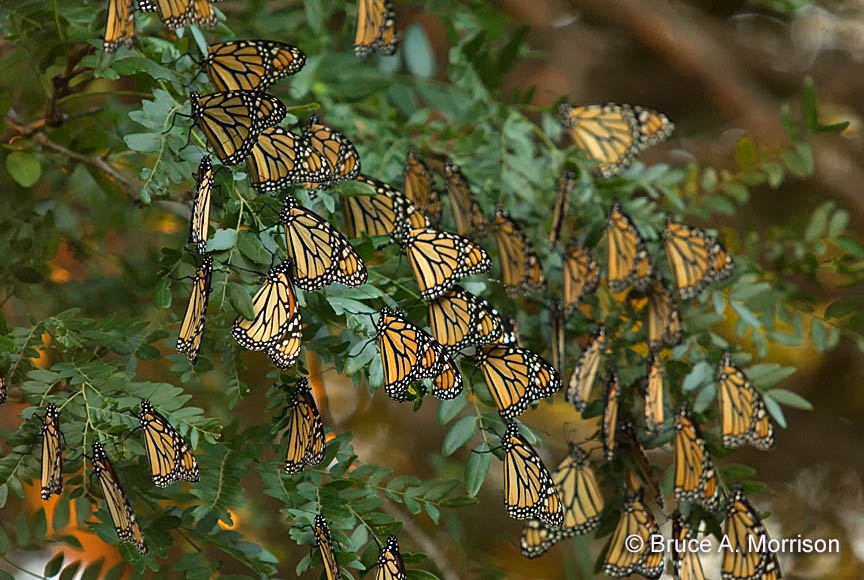
 Monarchs roosting in the grove here
Photograph - © Bruce A. Morrison
 
 Monarchs roosting in the grove here
Photograph - © Bruce A. Morrison
 
Now its up to the rest of their journey and the winter ahead in Mexico...I wish them the best of luck!

Monday, August 28, 2017

Monarch on Joe Pye
(photograph - © Bruce A. Morrison) 
click on image for a larger view
Late yesterday afternoon I was taking a photograph of this female Monarch butterfly on the Joe Pye weed next to the studio deck...somewhere in the back of my mind was the question - "When will the migration begin?  I believe it must be getting close."

"Valley Shadows and Clouds"
(photograph - © Bruce A. Morrison) 
click on image for a larger view
A bit later I noticed the clouds moving in with an intermittent breeze.  It felt like a front moving through.  I was distracted and spent some time looking skyward and photographing the landscape out front.  On my way back into the studio I noticed several Monarchs in the yard acting as if they were "gathering"; was a roost in the making?!!!

"The Roost Begins!"
(photograph - © Bruce A. Morrison) 
click on image for a larger view 
 
We actually had a roost in the yard - it wasn't a record breaker, like back in 2005 but it was a good first roost especially looking back the past 5 years here.
 
"A Small Roost"
(photograph - © Bruce A. Morrison) 
click on image for a larger view 

I could count 46 individuals; there were a few moving around so there certainly could have been more...tough counting these guys when they aren't totally settled in.
 
It's begun!  Lets hope for a good year for Monarchs in North America - and a safe winter ahead!


Thursday, March 22, 2012

Finally!


Pasque Flowers (Pulsatilla patens) on Waterman Prairie
Photograph © Bruce A. Morrison
(click on image for a larger view)

Spring is finally here and everyone's loving it!  Its really been here for quite some time...I'd debate its been here off and on since December!  Really weird weather the country is seeing.  There's a lot to debate about it too but I'll just enjoy what we're seeing for the time being.

Got out onto the prairie for the first time this year (if you don't count our prairie remnant here).  I knew I'd be late for the Pasque Flowers because the temps had been in the 70's-80's here the past couple weeks or so.  Yes they'd been up for a time it appeared.  A majority were showing a faded/worn look but the numbers were amazing; hundreds of plants scattered through the dead grass of last summer.

(click on image for a larger view) 

I've been buried in studio work all winter so this blog has been in hibernation so-to-speak.  I had committed to another one man show this spring so had to put in heavy easel time to get new things put together for it.  The theme is still "From the Tallgrass" , where else can my inspiration be coming from??!!  If you'd like to see paintings, drawings and photography from the tallgrass prairie in the next couple weeks, consider taking in the exhibit at the Witter gallery in Storm Lake.  There'll be an Artist's Reception on Thursday April 5th from 5:30-7:00 p.m.  Otherwise the exhibit will run from April 5 through the 26th.  It'd be great to see you!

The Monarchs are coming!
Photograph © Bruce A. Morrison
(click on image for a larger view) 

I've been following some "friends" this winter and spring (as usual) and I'm just amazed at how they're ahead of schedule!  It's being attributed to this "weather thing" but apparently the Monarch migration is about 3-4 weeks ahead of schedule.  I don't think they'll get too carried away unless their host plant (Asclepias sp. - the milkweeds) can keep up with their pace northward.  Last night I checked their progress, as I do each week, and they are already in Kansas and on the southern border of Missouri.  They don't usually hit these thresholds until April 15th or so...this is kinda spooky yet exciting!  I'll try not to get too worried about killing frosts just yet...I just thank God I'm not an apple or grape farmer here right now!!!

Have a great spring out there - hope to see ya on the tallgrass!


Monday, September 12, 2011


It has been a whirl wind summer!  Too bad it just does not slow down a tad, but that is just the way of things I guess.

We had our Monarch roost again this year here at the acreage.  It wasn't particularly impressive...about 300 the heaviest evening...down to just 9 last night.  But it was a neat sight none-the-less.  I suspect the Monarchs we're seeing now are from the pasture here...we were still finding caterpillars here on the milkweeds just 8 days ago; some of those individuals may now be adults feeding here.

The weather fronts have been moving them out.  The first morning after our high numbers, the wind had switched out of the north and Monarchs were rising above the tree tops and being blown south at quite an impressive speed!  (Hated seeing them leave but what can you do!?)

Journey North and Monarch Watch are still two really good sites to check out, report through, and support with your donations...its a remarkable natural heritage, and one I look forward to each year. 

Hope the last days of the summer are treating you well - see you on the tallgrass!

Wednesday, September 8, 2010

Fall Migration!

 Monarch Butterflies roosting in the west grove here just before sunset

I haven't meant to be delinquent with the blog!  I've actually been snowed under in related endeavors here at Prairie Hill Farm.  But sometimes things come up that require you to "sneak in" some time regardless.

It's the fall migration...or roosting that happens each year here at this time...not necessarily birds in this instance...although we've had many warblers passing through as well as Flycatchers and other songbirds the past 2-3 weeks.  It's the Monarchs!

Monarchs settle in for the night here after sunset

Each year we've been here we've had some roosting in the fall.  A couple years back was our largest roosting of upwards of a thousand butterflies...possibly slightly less, they're hard to count when they fill branches from 15-25 feet up!  This year we're seeing around 300-400 "countable" butterflies.  One thing I've found is when you go out in the morning to investigate - you often find more because they flutter their wings exposing the bright upper side when the sun begins to warm them.  This morning was no exception, I found many more roost covered branches than the evening before!

I send reports of sightings and roosts each year to the Journey North site; they have a Monarch migration tracking project that is followed by school  children all over the country.  It may sound small or unimportant but I feel kids are no longer in touch with their "natural" world like they were decades back.  Our natural heritage is more important than we can understand and to expose our kids of all ages to facets of this is extremely important!

The sun stirs the Monarchs to flutter as the sun warms them,
then they'll leave for the neighboring prairie pasture here to nectar through the day.

It was a bad winter for Monarchs this past year.  Their mountain winter roosts have significantly decreased and what roosting areas they still cling to are in bad shape.  This past winter in Mexico there were heavy rains which turned to freezing rain, causing high mortalities for the North American Monarch population.  

The Monarchs we have here now are that one unique part of the puzzle - they will be the ones to make the journey back to Mexico, winter over, and start the journey back next March!  Amazing!  They are the last generation for this year!

Get out and watch this amazing event if you can!