Wednesday, July 25, 2012

Heading South?!

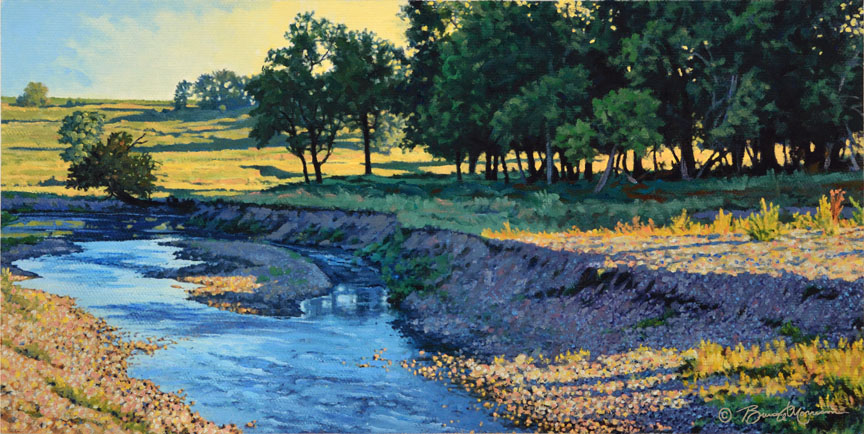
"Low water Morning"
oil painting - 6X12" - © Bruce A. Morrison
(click on image for a larger view) 

This is pretty much a re-posting from my studio blog...the conditions here on our own pasture and in area prairie remnants are continuing to "head south"!  I certainly don't mean that term as anything derogatory to "regions" - in this case I'm making an exclamation to our drought and heat this summer!
 
We've only had 2 tenths of an inch so far in July here...after less than an inch in June and with weeks of being in the high 90's - some in the low 100's, adding in some days of dehydrating winds, and things are getting nasty!  This isn't on a par of the droughts in other areas though...especially what Texas experienced last year.  Its just affecting more of the continent this year than has been seen in quite some time!

I'm grateful I'm not farming here this summer!  But if I were, the crop insurance would be the only blessing available!
 
Our native pasture is often my stronghold of inspiration...I'm sorry to say it is not the inspiration of past summers...at least not since about 3 weeks back.  The prairie will certainly get through the drought just fine, but the plants are now going dormant as they literally dry up before our eyes!  Another aspect of this is that we'll get little viable seed from the summer drought and heat.  The grasses and flowers are drying up as they go from the flowering stage to fruiting and maturation...many of the warm season grasses are simply losing flowers are they form...all drying up for the season.

Our early bloomers that I've been following through the spring and early summer are now becoming stunted or just plain drying up...it was fun while it lasted.  Well "unusual" any way!

The painting at the beginning of the blog was inspired in part by the dry summer we are struggling through this year.  I suppose if I were to go to this same spot today, it'd be even lower!  I do like the gravel embankments as an element of this painting - as well as the drama of the early morning light and the longer shadows.  I'm not sure if I'd feel the same about it as the water levels drop even more...but maybe treating the composition and light differently would make an engaging image as well.
 
Here's to finding inspiration in adversity!  Keep cool out there and hope to see you on the Tallgrass!
 

Sunday, July 8, 2012

Getting Used To It

New England Aster (Aster novae-angliae)
at Prairie Hill Farm - June 2012
photo © Bruce A. Morrison 
(click on image for a larger view) 

I think I'm getting used to it...not the summer heat and humidity, but the early blooming that has continued since early spring.  Another example here in the native pasture are the New England Asters.  The one pictured above was photographed the last week of June.  I was really taken aback by it;  these guys are usually an August through September bloomer!  Now we have even more asters blooming here...Smooth Asters (Aster laevis) and Silky Asters (Aster sericeus)...its just plain crazy!  (I'm afraid I'm beating that expression to death this year.)

My burning question sounds kind of stupid maybe...but if everything blooms so early this summer - what happens this fall???  Are all our September flowers going to be finished in August and all our October bloomers in September??!!!  We always have a tremendous push here by fall nectaring insects in late September and early October.  What is going to transpire here when that should be occurring?  Are the insects going to be early as well or miss that period and suffer?  I suppose if I see Monarchs migrating in August, that will answer that question for me.  We have been keeping strong numbers of Monarchs so far...we are over run by the milkweeds (Asclepias sp.) this summer.

Lead Plant (Amorpha canescens)
O'Brien County privately owned prairie
photo © Bruce A. Morrison 
(click on image for a larger view)

 I did manage to get out and walk a neighborhood native (private) prairie last weekend.  The slopes had been burned this spring, the first time I remember seeing them burned.  I was anxious to see how they fared and was pleasantly surprised!  I was about 10 days too late for what must have been an amazing Lead Plant blooming!  I did find a small number of individual plants with blooms that were later, but 95% were finished.  The grasses were robust and thick, and another plant that will have a boom there (if the bad drought we're experiencing doesn't hinder it) is the Rough Blazing Stars (Liatris aspera)...very thick there.

I retreated to Waterman Creek below this prairie and walked the creek bed for the remainder of the morning; it was already quite humid and oppressive...the retreat the the water provided, with somewhat leaky hip boots, kept me cool. I posted a 4 minute video of that walk on my art studio blog last week too.  You can see the video here -

There was a decent flush of Monkey Flowers (Mimulus ringens) along the creek bed there...I included one individual blossom in the video.  I don't know if the seed production of these will make it back to the seed bank this year though - its showing to be a potentially heavy infestation year for grasshoppers here in the county...the extremely dry summer weather is likely contributing. Past experience with Monkey Flower seed production has shown that grasshoppers absolutely love this plant's seed pods in the fruiting stage!

I've had some interest in the audio recording from the last blog here on The Tallgrass Journal.  I audio tape natural sounds as a hobby.  I've used lots of varying methods...some a bit experimentally, within a limited budget.  The audio I recorded of the prairie birds (Prairie Music audio file) was a crudely put together setup from existing equipment that worked extremely well and one that I hope to use more when I have time and opportunity.  I set up a web page if you're curious...it shows the setup - http://www.morrisons-studio.com/Audio-Dish-Plans.htm  ...to hear to recording again, just go back to the last blog here-

Keep cool this summer - see you on the Tallgrass! 
 

Tuesday, June 19, 2012

Having A Walk About (and barking dogs?)


Mid June forbs at the native pasture here -
(from the left - clockwise)
Echinacea angustifolia (Narrow-leaved Purple Coneflower),
Silphium lancinatum (Compass Plant)
and Ratibida columnifera (Prairie Coneflower)
Photos © Bruce A. Morrison
(click on image for a larger view)

I've tried to keep track of what is going on in our native pasture here, doing some thistle eradication and clearing some brome seed heads before they mature...I know that's like chasing your tail but its mental therapy for me.  

I followed up on an idea I had a year or two back and bought a battery powered hedge trimmer to cut seed  heads.  I originally thought of it for the brome but last summer got it specifically for the Stiff Goldenrod (Solidago rigida) seed heads.  The S. rigida has gone rampant down the gravel esker hillside in our north pasture...this hillside was predominantly Western Wheatgrass (Pascopyrum smithi) when we first arrived and ever since we've been encouraging the forbs, certain bad players are becoming dominant - in this case the S. rigida.  I'd say 35-40% of the NE slope is now dominated by it...I hate seeing the Western Wheatgrass get choked out, plus there are a couple very nice clumps of Prairie Muhly (Muhlenbergia cuspidata) there as well and I definitely want it to keep a healthy foothold.  

The only thing I accomplished with the trimmer was cutting off the S. rigida flower heads after their blossoms transitioned - before going to seed.  I still have a formidable issue with removing/thinning the S. rigida "plants" that are there now.  I usually sit down in a spot and just pull after a good rain.  What I need is a "bunch" of people to help but I'm "it" I guess.

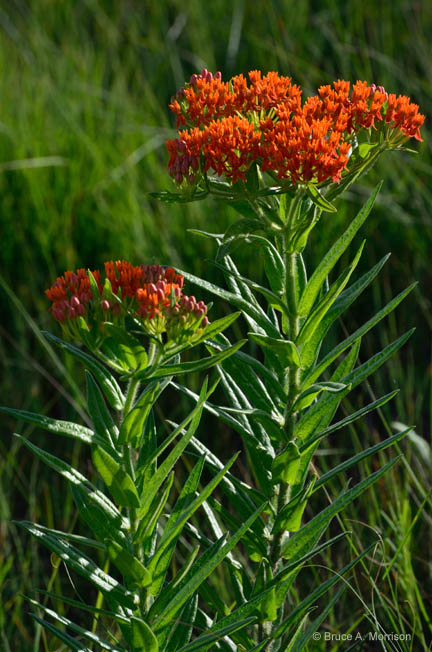
 Asclepias tuberosa (Butterfly Milkweed)
Photo © Bruce A. Morrison
(click on image for a larger view)

The pasture is still incredibly ahead of itself.  All the plants illustrated above are in full bloom now and they shouldn't be for at least 3 more weeks.  But it's great to see any time...I won't bicker about it!

This has also been a banner year for Dickcissels everywhere I go.  There was a reference made about them on the Iowa bird list serv recently and it made me laugh; it was a colorful reference to the Dickcissel numbers that others in the state are finding.  One birder referred to the Dickcissel's calling as "like barking dogs"; I suppose if you fixate on their constant calling they could drive a person crazy! 

I had to laugh because I see and understand the reference!  I still love hearing and seeing them each day, but we do have 2-3 times the numbers here than I usually record.  We have at least 3 nesting pairs in our east ditch alone!

I'm sure most everyone who is into prairies is familiar with Dickcissels, but if you're not you can watch the very short (just under a minute) video below as a reference to "call" and "plumage".  This male was singing from a fence post on our east ditch just a few days ago.  (If you subscribe to this blog via email, you can access the video directly from today's blog page.)


 (Dickcissel male in song - video)


I really enjoy the sounds on the prairie and have been trying, over the past 3 years, to record an Upland Sandpiper's "wolf whistle call"...at least that is one person's description of it.  I was on a state preserve 3 years back and was serenaded for over an hour by one.  Now I'd heard the call before but never at such close range and clarity, nor for so long!  I loved it!  Kind of like many people return from the northwoods with the cry of the Common Loon in their heads!

I've returned to the preserve each summer since but have yet to get the same performance.  I did get an awful lot of "Dickcissel" calling!  Or "barking dogs" as that birder put it :)  But the Upland Sandpiper only did its "flutter call" (my description) over head...the long trilling (wolf whistle) call was always a quarter to a half mile away.

 (Music of the Prairie audio file)

I'm going to post an audio file here for you of my latest attempt...you'll start out listening to the Upland Sandpiper's "flutter" call as it flutters 75 to 100 feet overhead, then you'll hear Sedge Wrens, Dickcissels...then Bobolinks, but the file is always resonant with the Dickcissels in and out of the background (those barking dogs again!).  An ocassional distant rooster pheasant will crow, and if you listen carefully, you may hear one or two "flutters" and then "wolf whistles" of the Upland Sandpiper a quarter of a mile away.  Enjoy it :)

Hope to see you on the Tallgrass this summer!


Friday, May 25, 2012

Still Here!

Golden Alexander (Zizia aurea)
photograph  © Bruce A. Morrison

I'm still here!  Its the spring season in high gear and I'm getting run over by it at each turn! 
 
 Prairie Smoke (Geum triflorum)
photograph  © Bruce A. Morrison
 
The prairie pasture here is no exception - everything is weeks ahead...ahead of itself and ahead of me as well.


Large-flowered Beardtongue (Penstemon grandiflorus)
photograph  © Bruce A. Morrison

The 2012 Artisan Road Trip is gearing up for its 2012 traveling exhibits for the season...the first show will be at the Witter...being that I just exhibited there last month - I need to find some things that weren't just there!  Easier said than done!


 Porcupine Grass (Heterostipa spartea)
photograph  © Bruce A. Morrison

Been trying to keep up with the inspiration the native pasture here has to give too, but its ahead of me as well as its usual self.


 False Gromwell (Onosmodium molle)
photograph  © Bruce A. Morrison
 
This year is different from any I've ever witnessed...I'm sure it has been for most of us out there.  The prairie pasture here has plants whose blossoms fried in the late frosts, after the unusually warm weather.  Those plants are probably going to bounce back but the weather has eliminated some of the early "stars" of the pasture...or made them very spotty this year.  The unusually dry late summer/fall and winter didn't help matters much though either.


 Prairie Phlox (Phlox pilosa)
photograph  © Bruce A. Morrison

But I'm still here!  I haven't forgotten the blog! :)  I'm just trying to catch up - just like the pasture here at Prairie Hill Farm! I hope you'll enjoy some of the plants that I photographed here this week!


Thursday, April 26, 2012

Rushing Forward!?

Bue-eyed Grass (Sisyrinchium campestre)
© Bruce A. Morrison

The signs of progress and the phenological records of the past just aren't in agreement this spring on the Tallgrass here.  For people who often get impatient (I'd probably qualify most of the time), its been a bonanza around here!

This week we've had May records broken easily...Monday had our first Monarch Butterfly flying through (had 3 yesterday)...surely looking for milkweeds to lay their eggs, because the specimens that Georgie and I have been seeing were very faded after a long flight from the south.  We do have milkweeds up - hope they find them before the poor things expire!

In fact I was out looking for milkweed plants and checking for possible eggs when I also discovered the the Blue-eyed grasses were up as well...looked like they'd been up for some time too!  I have never seen Blue-eyed grass much before May 15th, in fact that is usually my "go to" date when looking for them!

Monarch Butterfly (Danaus plexippus)
© Bruce A. Morrison

But Monarchs in April???  Here??!!  That is really unreal...I remember years when we waited well into June for them.  Well - welcome Monarchs!

Thursday, April 19, 2012

A Little Early...or Too Late?

Iowa Wetland Study No.1
photograph - silver halide print - © Bruce A. Morrison
 
I'm going to celebrate Earth day a little early, although it isn't until this Sunday.  This will be its 42nd year and its now observed in 175 countries.  The thing that saddens me about our attempts to celebrate our planet is that we are truly in need of observing this day 24/7/365...did I get that right?  I mean every day we draw breath - all year long.  
 
In my life time I've seen promise...more restrictions on industrial pollution, attempts to restore habitat and set aside more for our great grandchildren.  Many success stories of bringing species back from the brink.  Other issues too numerous to go into here.  
 
But there is overwhelming opposition to these issues as well.  Cries of removing government restrictions on industry...regulations, etc.  I always try to be upbeat, even when I don't feel that way, but this is too important...its our lives...our legacy to our children's children's children!  
 
The photograph at the top of the blog was the first 4X5 large format photograph I ever took of a prairie wetland - almost 40 years ago.  Its one of many images now on exhibit at the Witter Gallery in Storm Lake, Iowa in my solo exhibit titled "From the Tallgrass".  The photograph is a sad reminder to me - its of a wetland that is "no more".  Its now covered in asphalt...it was a beautiful working ecosystem - now the ground no longer breathes there, no conversion of CO2, no cooling the summer air nor filtering runoff and pollutants.  Wetland choruses no longer sung.  Asphalt.
 
Recently there was a bill in the Iowa legislature to sell a thousand acres of Iowa public land.  The gist of this bill was to sell 1000 acres of public land that could still be farmed.  Now I don't know what the legislator(s) who put this language into the bill were thinking of using the money for that would come out of a sale of public land, but this was our land - your land , your grand kid's land.  Iowa is "the" state in this union known as "being the most changed" as far as its resources...its natural heritage.  AND someone "still" feels we've gone over the top and need to sell parts of a park, or preserve, or prairie ground to return to what it was rescued from!  You'll hear arguments of a need for more corn to feed livestock, for more income opportunity for some individual(s), for more land to give back to the state's coffers in taxes.  There's always a reason to go back, to not look forward to what our future is potentially holding for us if we only think in the "Now".  Thank goodness there were enough voices raised with this bill (mine included) that the language was dropped. 
 
So I'm starting to celebrate the official Earth Day a tad early and plan to keep celebrating, being concerned, loving and embracing this amazing rock we're circling that close star with. 

 White-throated Sparrow - male
photograph - © Bruce A. Morrison
(click on image for a larger view)
 
I'll celebrate with the little things - this morning the White-throated Sparrows returned!  They'll be around now for a few weeks before continuing on north to their breeding grounds.  I'll celebrate them and every spring migrant that pauses as they pass through.  I'll celebrate the rain we're receiving today!  I'll celebrate the old farmstead we live and work on...not as farmers but still embracing the earth with our vegetable gardens, berry crops, the native prairie pasture, the bee hives lending a hand with pollination.  I'll celebrate the Earth each day with my art work and photography...with the sounds and smells that are our natural heritage.  I'll support organizations that are working hard to preserve this natural heritage - not squander it on the profit of the moment.

In Iowa, check out and support really worthwhile organizations - with your heritage in mind; like the Iowa Natural Heritage Foundation and the Nature Conservancy or any related organization in your own state or country.  And an excellent publication that shares what others are doing every day to embrace their natural heritage is Woodlands & Prairies Magazine...I highly recommend these!

Its not too early to Celebrate Earth Day.  And it is not too early to care...to "Really" care.


Sunday, April 1, 2012

Wonderful

Pasque Flowers (Pulsatilla patens) on a private remnant
Photograph © Bruce A. Morrison
(click on image for a larger view) 
 
90 degrees this afternoon here at Prairie Hill Farm...and its not April Fools!  Or maybe it is...the weather's getting a good laugh anyway. 
 
I finally got out onto some private remnants here in SE O'Brien County about 3-4 days back and was pleasantly surprised to find some more Pasque Flowers - right where they should be!  The ground is native pature that's been grazed for many years, but the hilsides are steep and I suspected, last year when I was first given permission to walk there, that the slopes looked like they should have some pasques...they were there.  Wonderful!
 
The Wild Plums are also out now...this is 25 days earlier than last year.  What else is new - everything is a month ahead of itself! Why I even just finished "mowing" the fire breaks a half hour ago on our own native pasture here and that's no April Fools either!  Never had to do that in April before.
 
We did get our north pasture burned in March...we're leavig the south pasture and the ditches alone this year though...giving the invertebrates and "us" a rest there.
 
The only thing that I messed up on is my seeding.  The weather just became so warm so fast that my planned late winter seeding never happened.  I suppose I'll try it as soon as a "sure thing" for rain is on the horizon - we've really missed out on precipitation and are listed as being in a "severe" drought here in this corner of the state right now.
 
 (click on image for a larger view)
 
Next on our agenda is hauling our "From the Tallgrass" exhibit down to the Witter Gallery in Storm Lake for the Thursday night opening and artists reception (5:30-7p.m.), the exhibit will be there through April 26th if you can't wander down next Thursday. 
 
Hope to get to see more "wonderful" things this spring - hope you do too!  
 
See ya on the tallgrass!