Tuesday, July 27, 2010

Bio Blitz

 Prairie Larkspur
(Delphinium virescens)

Ever been to a Bio Blitz?  I witnessed my first one last summer at the Lost Island Prairie Wetland Nature Center north of Ruthven, Iowa.  It was a blast!  Various professionals in different fields headed groups of volunteers out into the marshes, woodlands, and prairies in the Lost Island Lake area.  Each group was focused on a specific plant, animal or invertebrate, and would explore the area's habitat for those species and tally what they found.  I had volunteered last year to just float from group to group as they inventoried their finds and found it fascinating what everyone was finding.  

Lost Island Naturalist Miriam Patton is carrying out another Bio Blitz this summer and asked me if I would help with the "prairie plant" part of this year's effort.  If running around and identifying prairie plants interests you - why not come over and join us!?  Besides - I "really" could use the help!  More eyes and heads are often better than one.  Any way, it'll be fun!  If plants aren't your thing, you can also volunteer to assist in finding Butterflies and Moths, Birds, reptiles, amphibians, mammals, aquatic specific species, and so on!  What could be more fun than that?  :) 

I'll paste an agenda here for more information -

Those interested in participating should make reservations by calling the Nature Center at 712-837-4866.  Let us know which session(s) you will be attending.  There is no charge for this event.
The schedule is as follows:
Saturday, August 7
12:00 -1:00  Registration at Nature Center
1:00 Welcome and logistics
1:30-5:00  Field Session
5:00-5:45  Sack Supper
5:45-7:45  Field Session
8:00 Lake Management Update
9:30 Moth Field Session
Sunday, August 8
6:00-8:00 Bird Field Session
9:00-12:00  Field Session
12:00 Sack Lunch
1:00 Final Report
Bring a sack lunch/supper, wear sturdy shoes that can get wet or muddy (no flip flops or open toed sandals), sunscreen, bug repellent, water bottle to re-fill, and binoculars.

 Wood Lily
(Lilium philadelphicum)

One thing I find interesting about identifying forbs during mid to late summer is identifying the late spring and early summer plants with their seed capsules in place instead of their flowers.  I often wish I'd find the time to photograph forbs in seed...would you recognize the Prairie Larkspur gone to seed?  I think it's amazingly similar to the shape of columbine when it's gone to seed...except larger and paler, maybe even somewhat more "papery" (if that's really a word!?).

If you're familiar with lilies in your garden, then you'll likely recognize the Wood Lily gone to fruit...these are perhaps some forbs we'll be able to find at the "Bioblitz:  A 24 Hour Nature Scavenger Hunt" at Lost Island on August 7th and 8th.  If you're free, and game for a real "hunt", come on over and give me a hand!  :)


Tuesday, July 13, 2010

Pondering Leafy Spurge

July morning in the Waterman Prairie Complex
(click on image for a larger view)

Spent a morning recently on a photo field trip to a section of the Waterman Prairie complex just south of us.  Was curious about the Leafy Spurge situation on a favorite gravel esker; I hadn't been there in "season" in some time.

I found some very nice stands of Echinacea (E. angustifolia), 4 species of Asclepias (milkweeds - Green, Sullivant's, Butterfly, and Common), Compass plants (Silphium lancinatum), Toothed Evening primrose (Calylophus serrulatus), amd many other forbs, with plenty of native grasses such as Hairy grama (Bouteloua hirsuta), Prairie muhly (Muhlenbergia ?), Big bluestem (Andropogon gerardii) and Side oats grama (Bouteloua curtipendula) - all beginning to flower already.  Things seem to be ahead of past years due to our region's record rainfall and warm weather.

 Leafy Spurge
(Euphorbia esula)

The Leafy Spurge situation in this particular locale has not improved, it has nearly engulfed the disturbed slope leading up the esker and is now making some inroads onto the crest of the knob.  A few years ago a grad student from Michigan University would show up for a few weeks and spend a great deal of time documenting the incursion and it's affects on the neighboring plant communities.  I had some secret hope that he'd have some recommendations or an epiphany or something that'd help the situation!  But that was a few years ago now and nothing has changed there.

I can't fault the county or DNR on this predicament...I see it all over.  I do believe that if it were a legislated issue, we could get it under control.  That's a real can of worms though and don't really care to get into where that conversation would lead!  But if land owners over the county and state took this plant seriously, the rest of the areas still fighting it off would make real progress.

I don't know if Iowa has started a flea beetle program or not?  Some neighboring and regional states have and give out the flea beetles to land owners to disperse and I'm reading some encouraging results.  But it's a complicated situation and often requires several control approaches, not just one (flea beetles).

Apparently Leafy Spurge is toxic to cattle so any pasture ground effected by it becomes pasture lost for grazing.  However, sheep and goats can and will graze on Leafy Spurge, and studies have been done the past several years on grazing sheep or goats as part of a multi control approach.  Goats will apparently graze spurge completely down but it will return after they are rotated off a site.  Some success has been found combining flea beetles with goats or sheep though.  Maybe fencing small portions of an affected site and moving the enclosure periodically could be a helpful approach?

I was reading a paper from the Colorado State Extension, it mentioned that there are 4 types of flea beetles they use, as not all are suitable for "all" locations.  Interesting - I thought a Leafy Spurge Flea Beetle was just one insect, but there are several types and that's been part of the studies done the past several years.  Their habitat requirements vary, and although they don't entirely understand, they have identified which beetles prefer which type of habitat - you'd tailor your situation to suit a particular beetle for the best results.

For people that are unaware of invasive/exotic plants, none of this may seem the least bit important.  But if you witness this phenomenon first hand in a habitat you personally care about, it is most disheartening.  It is something like watching a loved one slowly succumb to a disease from which they apparently will never recover.

Our natural heritage is harder to secure as each year passes.  It is not wise to squander what your grand children deserve to experience and enjoy!  Look for answers and make inquiries...volunteer to help the environment in your area...do whatever you can, it's worth the effort.

Sunday, July 4, 2010

July...A Window Into The Whole

Canada Anemone
(Anemone canadensis)
click images for larger view

This amazes me to no end, always has, always will...how does time pass so quickly?!  It's already July!  

When I was young...very young, time was a chain that prevented the enjoyment of the natural world...glued to the window during class in school I griped about the day wasting away "out there", while trapped inside - not wanting to learn what I was told I must!

Now, it (time) is so fleeting and the natural world progresses, through the many processions of blooms and bust.  Even with the native pasture here, it is difficult to not miss things, and when you miss something, you usually must wait till next year!  (But at this rate - that doesn't seem to take very long anymore!)

I walked a favorite prairie close to home one evening this past week. The Porcupine grass was standing tall and mostly naked; nearly all their quills had been given up to the ground.  The Canada anemone blooms, which were quite prevalent in this same space only 2 weeks ago, were becoming rare...their seed now forming.  

The air was full of sounds of insects.  This is a sweet sound to me now...may not have been in earlier naive years.  I once found myself a quarter of a mile from the road in a boggy area of SE Iowa, photographing Bur Marigolds (Bidens aristosa) in a mass bloom I've not seen anything like since.  I was photographing with my old Crown Graphic 4X5 camera and heavy old tripod.  When I finally set up for a shot I realized a now nearly deafening drone of bees.  I looked around and almost immediately had to suppress a feeling of panic.  I had to have nearly a hundred solid acres of bees busily working all around me!  I was an island in the middle of these insects. The slogging walk back to the car, in my chest high waders, was made much harder by now trying to avoid upsetting any of the "quadrillion" (my mentally disabled estimate!) bees in a feeding frenzy!  I knew then, and know now, that I had nothing to worry about as long as I stayed upright - these insects had the same distraction I had (the flowers!) and were unconcerned or aware of my incidental presence!

I have always been interested in insects (invertebrates) and I suppose if I'd had my 35mm camera with me at the time I might have spent the next hour trying to get back to the car, photographing bees pollinating these forbs!  

I've become more interested in invertebrates in recent years here at our acreage and native pasture.  I've mentioned many times in past "A Tallgrass Journal" entries, about trying to balance the maintenance of the small remnant and the reconstructed areas with fire and mowing "and" leaving it alone...for the good of the insects.  This subject has become, perhaps one of the most important and discussed parts of prairie biodiversity (health).

With prairie remnants so dissected, fragmented - and small, the total picture is seldom still intact.  The prairie, as a real habitat, is in more danger of no longer existing as it once did than nearly any other type of habitat in our region of the country.  It all works together, as so eloquently put in "The Emerald Horizon, the History of Nature in Iowa", by Connie Mutel (see "A TAllgrass Journal" Vol.7 No.1)

Invertebrates are so key to the tallgrass diversity, as are the plants...but the ecosystem will not hold together integrally without the invertebrates.

I've noticed the pollinators among them (invertebrates) over the years and find it fascinating.  I never gave pollination much thought years back, until we became more familiar with some economic impacts of them...such as bees with world food crops.  In our region, much of our most common grain crops (corn and soy beans) are wind pollinated so the importance of pollinator health is nearly unappreciated.  This is unfortunate and many say "short sighted", as pollinator health is a key to world food production we should not disregard!

 Butterfly Milkweed (Asclepias tuberosa) with ant
(you'll have to click on the image to see the ant!)

One thing I've noticed out on our native pasture in recent days is the variety of pollinators one usually does not consider as such. I often see ants on various forbs...many time they'll be with aphids of course but often pollinating, gathering nectar and/or pollen and becoming important to specific plants.  The asclepias (milkweed) is one forb I often see ants working.

 Common Milkweed (Asclepias syriaca) with Mosquitoes
(click on image for larger view)
One insect that I've seen participating in this process, that surprised me are mosquitoes (!).  I remember hearing that mosquitoes also feed on nectar, but figured it must be the males, because we all know what the females feed on!  (ouch!)  But I've noticed many, many examples the past week of female mosquitoes inadvertently pollinating plants...especially the milkweeds.  Do they feed on others?  Well I'm guessing so, it's likely the opportunity that presents itself (?).  Wouldn't it be nice if female mosquitoes would prefer nectar to us!!!

 Whorled Milkweed (Asclepias verticillata)with Great Golden Digger Wasp (Sphex ichneumoneus)

Another insect I see feeding on nectar are wasps.  Or perhaps it's the pollen they are after, or both?  I'll have to study this more.  But one wasp I really like here is the Great Golden Digger Wasp.  They seem to feed on whatever is in bloom, which at the moment are the milkweeds.  The Great Golden Digger Wasp seem to really be attracted to the Whorled Milkweeds here, and then when they're done - the Goldenrods.

Interesting what's out there and what niche they partake. Well, they not only make fine music but as a group (the invertebrates) are part of the glue that holds the tallgrass prairie together...some may be not so pretty to others, but the natural world is shaped by them and our food throughout the world hinges on their health.  

Sunday, June 27, 2010

Plant Dilemmas? Does It Matter?

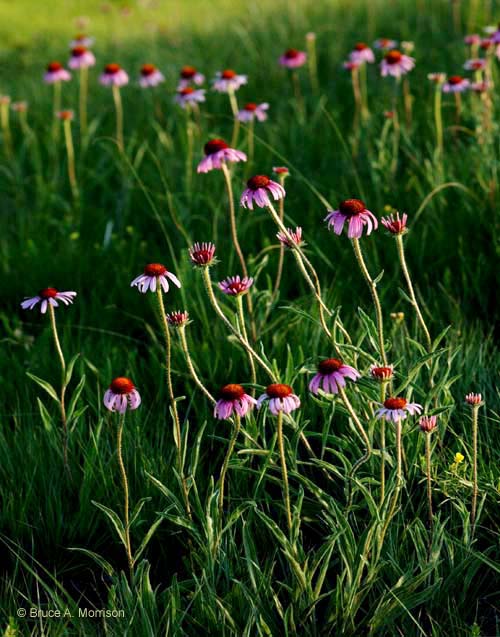
 Narrow-leaved purple coneflower
(E. angustifolia)

Have you ever had some activity ultimately bringing a lot of unforeseen decisions and issues? 

I'm in the middle of a labor intensive situation here at Prairie Hill Farm.  Last year the county took 24-28" of soil out of our road's ditch and added it to the top of the road.  The ditch sides are very steep now; the property side is something like a 70-75 degree slope and the road side is 55-60 degrees.  They're now about 5 and a half feet deep if not more so!

The county gave me a couple small buckets of native seed late in the fall after accidentally planting the ditch in brome and other vulgarities(!).  I'd requested a native seed mix that the county has from a statewide grant from the University of Northern Iowa., but they evidently didn't tell the guy that was doing the actual seeding! Well, I got to kill the ditch during a late November warm spell and started over again this spring.

It's been a ton of work, hand pulling and now cutting all the nasty things that plague these situations (Lambsquarter, Buffalo Bur, Nightshade, Canada Thistle, Sow's Ear, Ragweed, etc, etc...).  The ditch sides are too steep to mow and the June precip is torture - 14.35" here just this month!  If I could count on that every year I'd opt for wetlands plantings!  In the meantime I'm wondering how much of the seeding that's coming up will drown out?  (Its in standing water as I type this)

I think that's par for the course isn't it, also Murphy's Law usually comes into play as well.  But something that I've thought about on more than one occasion has me wondering.  I'm seeing some Pale purple coneflower coming from my ditch mix.  What's the problem?  Well, maybe none, but I'm leaning toward not being sure I like that!

I've always had a pet peeve about working on native plantings with things that aren't necessarily native to that location.  I'm in O'Brien County; the only native echinacea I've been able to find in O'Brien County is E. angustifolia, not E. pallida.  I've been hard pressed to find Pale Purple coneflower anywhere near here - except in plantings done by "People". But is having some Pale purple coneflower in the ditch going to cause issues with the Narrow-leafed Echinacea in the native pasture?
I have no idea.  Does it matter?   Again...no idea.  But somehow it seems like I'm sleeping with the other side if I let it go...

It's just a ditch!  Ya but...oh well...what do you think???!!

Now, I have had some garden variety Purple coneflower escape into the pasture edge and promptly did away with it (E. purpurea), but I'm trying to keep the pasture on a course of it's original plant species and domestic plants are not helpful in any way (nor desirable).

Prairie spiderwort
(T. bracteata)

I try not to introduce things that would not have been here 2-300 years ago.  Another plant I see show up in "conservation" plantings that is not native to this part of Iowa is the Ohio spiderwort (Tradescantia ohiensis).  The spiderwort native to this region of the state is the Prairie spiderwort (T. bracteata) - a shorter plant happier in gravelly drier sites, has longer bracts than the Ohio.

Do you suppose I'll find T. ohiensis in the ditch in future years?  Should I care???!!  Does it really matter?  Geeze, I haven't the foggiest!  What do you think!?

Thursday, June 17, 2010

On The Tallgrass with A Tallgrass Journal

 Prairie Coreopsis and Prairie Phlox
(Coreopsis palmata and Phlox pilosa
(click on all images for a larger view)

If you have been a subscriber to "A Tallgrass Journal" you certainly noticed the past year's hiatus I've taken from the journal.  After long deliberation I've decided I can no longer support the lengthy time spent making even a quarterly journal work.  I carried it for 7 years but have made the decision to change it's format to a blog.

I hope you can still find some good reading, information or even a diversion following the occasional posts from the new "A Tallgrass Journal".

I'll still discuss a good "read" I come across; an informative and useful link or website that could be valuable to prairie enthusiasts or owners; and even interject the struggles here at Prairie Hill Farm's prairie.

There are no goals for set time frequency for the new "A Tallgrass Journal" blog.  I hope to use it with regular frequency, but the postings will be typical blog length and likely limited to one or two issues/observations/etc at a time.  I hope this will be more spontaneous and interesting for prairie folk and the uninitiated as well!

I hope you'll stay with A Tallgrass Journal and drop in from time to time - and even comment!  Blogs are perfect for injecting a point of view or to correct me if I need to be!  :)

When I think of the prairie I think of grasses, forbs (wildflowers), birds, mammals, reptiles, amphibians and invertebrates (insects).  As an artist, I work on what interests and inspires me...that's what anyone should do.  The tallgrass prairie interests me.

In my 3 year old blog "Prairie Hill Farm Studio" you'll often see artwork...paintings, drawings, and photographs with the prairie as the subject matter...why wouldn't I be inspired by it?! :)  I'll still illustrate this "A Tallgrass Journal" blog with photographs I take in the field or the remnant pasture here, and even occasionally with drawings or other artwork to illustrate a topic.  And unlike the web based journal of past years, you'll be able to click on the images for a larger view.  I'll make an effort to give a relatively good size image file to view, yet not so large as to make you have to scan back and forth too much on your screen.

Today I wanted to share a couple cool season natives we have here in our north pasture remnant...yesterday morning was my first opportunity in 2-3 weeks to get out and walk the prairie myself!  The morning was perfect for the camera...barely a breath of wind makes photographing grasses and forbs simply a pleasure!  


Porcupine grass (Stipa spartea)

A couple grasses in our remnant pasture are flowering and fruiting nearly the same time - one is Porcupine grass (Stipa spartea)...the other is Scribner's panic grass (Panicum oligosanthes).

Georgie and I started the Porcupine grass here ourselves and it couldn't have been easier.  We simply walked the roadside ditch just south of us and picked the "awls" when they began to start releasing in late June.  Planting this grass is as simple as sticking the needles into the ground...maybe a half inch or more...the awls will take care of the rest.  They twist and turn the seed into the ground the rest of the way as they dry.  Try putting some in an envelope right after you pick them and then look at them a few hours later...they will demonstrate their ability to twist them selves into the soil on their own!

   Scribner's panic grass (Panicum oligosanthes)

The Scribner's panic grass is localized in a small area on our north pasture.  We have another type of panic grass here too but the Scribner's seems to be more numerous at some higher quality prairies - which makes it more special to our site.  I did not find this grass here until our 2nd or 3rd year here.  I'm going to try and ensure it gets some space and do some manual seed spreading to see if it becomes more plentiful in future years.

On my "studio" blog I recommend people look closely at the grasses - I certainly find them inspiring!  In the mean time I'd just suggest - stop and take a real close look, even touch or step back and admire as well...there's a lot to see on the prairie.

Hope to see you back again when you're out on the Tallgrass!